

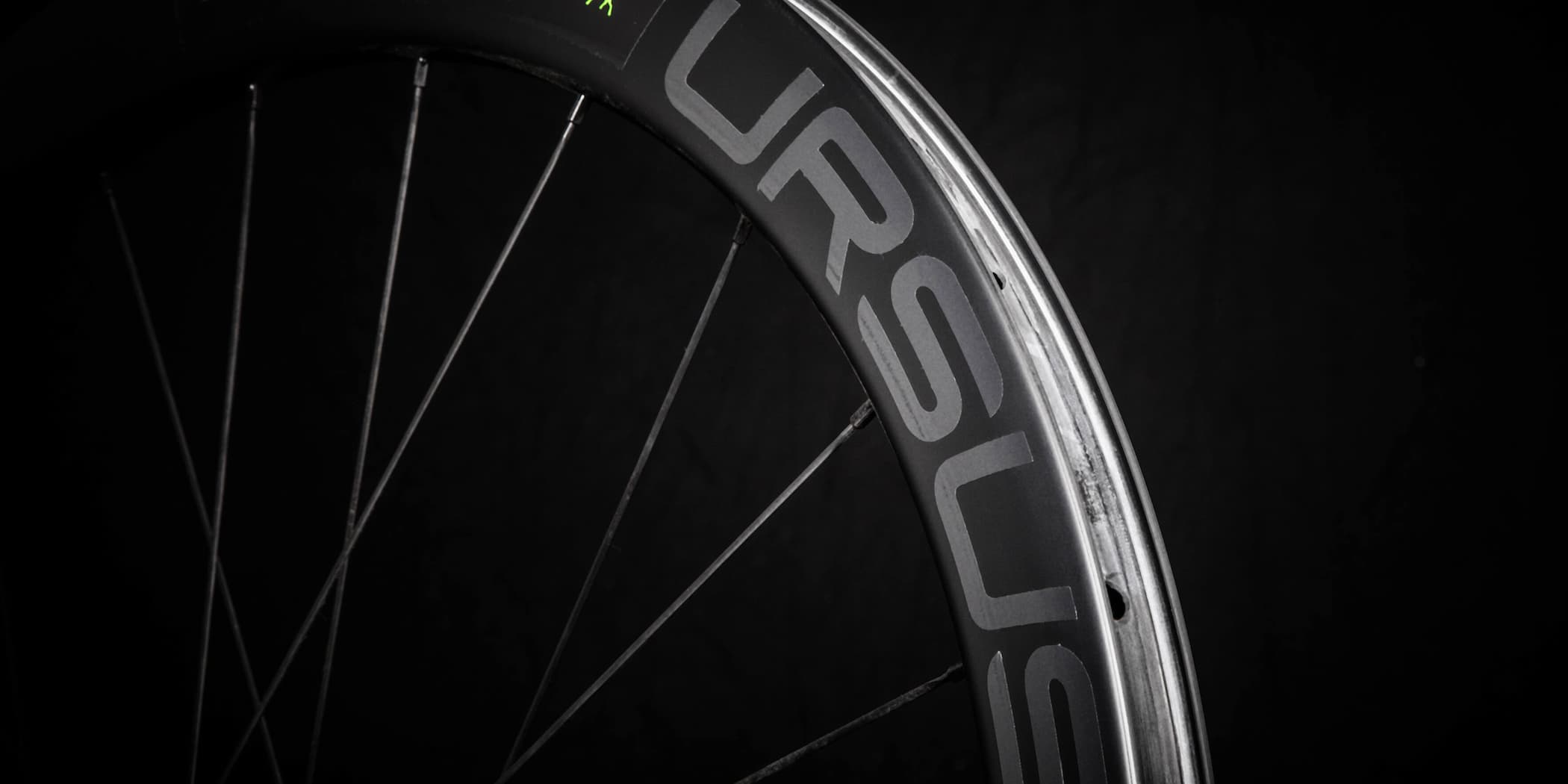
Knowing the details of a road bike wheel can help you understand whether the stock wheels on your bike are up to par or whether you can do something to improve the overall setup.
In this article, we'll see how a simple assembly of rims, spokes, and hubs becomes a drivetrain system that can increase the performance of your bicycle.
What is the role of road bike wheels?
Road bike wheels are an integral part of your bike setup. Therefore, buying a frame with top-of-the-line components will be of little use if the wheels don't perform well.
What does high-performance mean? A good wheelset must ensure great smoothness, reliability , and have the right weight . Comfort and safety must also not be forgotten.
What are the components of a racing bike wheel?
A racing bike wheel is essentially a rotating mass, whose characteristics derive from the combination of different components that withstand the varying physical forces resulting from rotation. The hub, spokes, rim, and tires must be designed to ensure maximum efficiency in this regard.
Let's now analyze the components of a wheel in detail.
1) HUBS
Hubs are the heart of the rotating movement, responsible for transforming the force applied by pedaling into centrifugal force that is then applied to the spokes. The rear wheel and front wheel use different hubs. Hubs also ensure the smoothness of the bicycle: minimizing friction between their components is a key step in producing quality hubs. You can find two types of hubs: hubs for drum brakes are different from those for disc brakes.
2) QUICK RELEASE
The quick release is a convenient system for removing and attaching the wheel to the frame.
As the name suggests, it was created to speed up wheel changes, especially during racing. It essentially consists of a pin inserted into the hub. Through a system of nuts, springs, and levers, the quick release becomes one with the hub and allows the wheel to be secured to the bike's dropouts.
3) RAYS
Spokes are essentially tie rods that serve a triple function: they provide stability to the rim, keeping it in place, but they also support the weight of the cyclist and the bicycle. They also absorb shock from the ground.
Spokes can be curved or straight-head. Today, the best spokes for racing bikes are straight-headed, as they ensure better distribution of traction. Straight-head spokes require dedicated hubs: the reason is that this particular type of hub allows for assembly aimed at obtaining a wider camber and therefore a more stable wheel. The spokes can be tightened or loosened using nipples.
4) NIPPLES
Nipples are a kind of elongated nut. They are mounted on the end of the spoke and nestled in the rim's slot. By rotating, the nipples can adjust the tension of each individual spoke, ensuring greater or lesser stiffness.
5) CIRCLES
Rims are the external mechanical part of racing bike wheels. They are connected to the hub by spokes and can accommodate tires. There are many rim variations: the main differences depend on the material they are made of as well as the thickness of their profiles and their internal channel.
Internal channels of different sizes allow the mounting of different types of tires, while different rim thicknesses determine different uses of the same: for example, a high-profile rim is ideal for time trials as it ensures greater aerodynamics, while a low profile is more performing uphill.
In terms of construction materials, the most common are carbon and aluminum. Aluminum is the traditional material used for bicycle rims, but installing a carbon rim allows for greater wheel stiffness and a reduction in weight.
6) COVERINGS
Tires are the component of the wheel that directly contacts the road. Their job is to provide the necessary road holding .
There are many tire options available in stores, but they fall into two main categories: "tubular" and "clincher." What's the difference? Tubulars don't have an inner tube, while clinchers do. Tubulars are generally lighter, but less practical in the event of a puncture. Due to their design, they're more complicated to replace, unlike clinchers, where simply changing the inner tube is enough to keep riding. Tubulars and clinchers require dedicated wheels.
Conclusion
So what does a racing bike wheel look like?
Your cycling wheels are a complex product, the result of the mechanical balancing (truing) of various forces that create equilibrium. The combination of hub, quick release, spokes, rim, and quality tire creates a high-performance, safe, and reliable wheel.
Want to make sure you've got the best road bike wheels on your bike? Learn how to choose the right wheels by reading this article.


