

Triathlon accessories certainly won't make you surpass yourself in a race: they will be consistency, training, passion, and determination . However, the right equipment, technical clothing, and a great triathlon bike are essential to compete at your best.
Do you already know what you can't do without?
Before leaving
The race is about to begin, and the adrenaline is pumping. Check that you've packed everything you need in your backpack—or rather, your transition bag:
- hydration and nutrition kit;
- bike repair kit;
- bib carrier (the most comfortable are the one-shoulder ones, which you can quickly turn onto your back and stomach);
- GPS watch and sunglasses.
Here we are. Let's get to the heart of the matter.
Swimming: Triathlon suit or wetsuit?
Swimming is the first discipline in which you will challenge yourself and other triathletes.
The regulations vary depending on the National Federations and the races you'll be participating in. The Italian Triathlon Federation, for example, has very detailed regulations regarding race clothing and accessories .
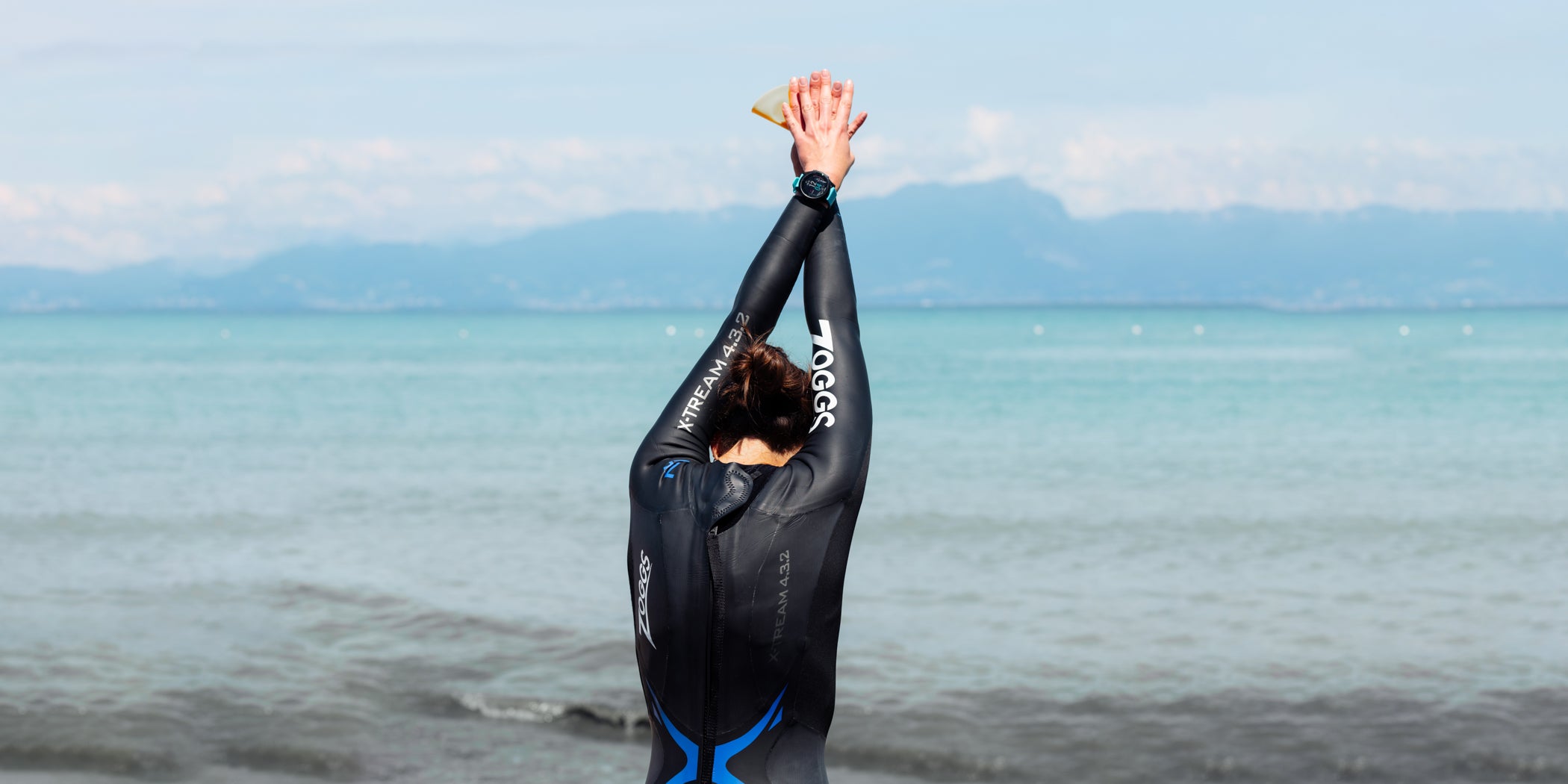
In some competitions, in cold waters, wearing a wetsuit will be mandatory. In others, in warm temperatures, it will be banned. The triathlon wetsuit is designed and manufactured to provide thermal insulation and prevent water from entering, minimizing drag and promoting buoyancy. These wetsuits are very different from surfing or diving wetsuits.
More often, however, you'll find yourself wearing a triathlon suit with three functions in one , to facilitate athletes' transitions. This garment is designed to be comfortable for swimming, cycling, and running. The trifunctional suit is hydrophobic, yet high-performance, breathable, and quick-drying.
In some races, the use of a two-piece uniform (top and shorts) is also permitted.
In addition to a wetsuit or bodysuit, triathlon clothing for open water swimming always includes goggles and a cap.
Want some advice on how to dress correctly? Always read the competition rules carefully. Failure to do so will result in disqualification.
Running: How to Choose Triathlon Shoes
You've just jumped out of the water and it's already time to start running. If you're wearing a trisuit, you can continue the race in your regular triathlon gear. Put on your shoes and get going—another challenge awaits.
One of the main problems encountered by those who approach triathlon for the first time is having to adapt to using normal running shoes: in fact, there are no triathlon shoes designed specifically for this purpose.
So choose running shoes:
- breathable;
- flexible;
- suited to the anatomy of your foot.
A useful trick is to wear shoes with speed lacing (or with locking laces), because you will be able to put them on more quickly during transitions, avoiding the risk of them coming undone during the race.
In cycling, accessories make the difference for your triathlon bike
We're in the final stretch of the race. You can feel the road rushing under your tires and your quadriceps pushing hard. What do you need to maximize your performance?
Cycling shoes
Beginner triathletes also tend to use road bike shoes, with notches, perhaps with toe clips. When you want to take things to the next level, we suggest investing in triathlon bike shoes, which are designed to be slipped on quickly, even without socks , and have an extremely quick pedal locking system. These shoes are flexible and offer good ventilation and breathability, keeping the foot more comfortable during the race.
The helmet
Helmets are mandatory in cycling races. The most important thing is that they offer adequate head protection, which is why you must purchase an EN 1078-certified helmet.
Some beginner athletes use road bike helmets. More experienced athletes prefer teardrop, closed, and aerodynamic helmets.
The triathlon bike
There are triathlon bikes designed specifically for our sport: the most popular are chronobikes, extremely aerodynamic and, with the right wheel and tire, also achieve excellent stability in crosswinds, without losing a single watt.
But if you're just starting out, you can adapt your road bike or mountain bike by adding triathlon components and accessories. Obviously, a road bike is better suited to fast routes, while a mountain bike is better suited to uphill routes.
What are these accessories?
Extenders are bars that attach to the handlebars to adapt racing bikes or mountain bikes (triathlon bikes already come with them). They allow for a more functional posture for the back, as well as being more aerodynamic.
Two other key elements are the saddle, which must be first of all comfortable and secondly aerodynamic, and the pedals, equipped with quick locking systems for the foot.
Finally, the wheels that will take you from one end of your race route to the other are fundamental.
Wheels for bikes
Choosing the right wheel isn't just a technical matter, which will allow you to reduce your lap times, but it's also a choice of the heart . Through the wheel, you feel the road beneath your body, and its rotation becomes one with the work of your muscles.
So, to choose the right wheel for you, you need to consider three options:
- High-profile wheels are ideal for high-speed courses , even long ones. They are extremely aerodynamic and durable and are made of carbon to reduce the weight of the structure and improve performance. They are particularly popular in Iron Man races , for example, when shaving a hundredth of a second off the pace can change the course of the race;
- Low-profile wheels are slower but can absorb shocks and impacts . They are generally preferred for uphill races or those with rapid changes in direction and speed;
- Medium-profile wheels represent a good compromise between the two previous types . They don't have the same aerodynamics as high-profile wheels, but they guarantee greater stability, especially on endurance courses.
Now that you know which type to choose based on the race you're competing in, all you have to do is learn the final secrets to the perfect wheel. What really makes the difference in a race?
- The materials used to make the wheel, mainly carbon or titanium;
- Technologically advanced planning and design;
- The hubs and spokes, which if structured and made in detail can optimize performance;
- The tire: clincher to provide stability or tubeless to favor speed and dynamism when racing.


