

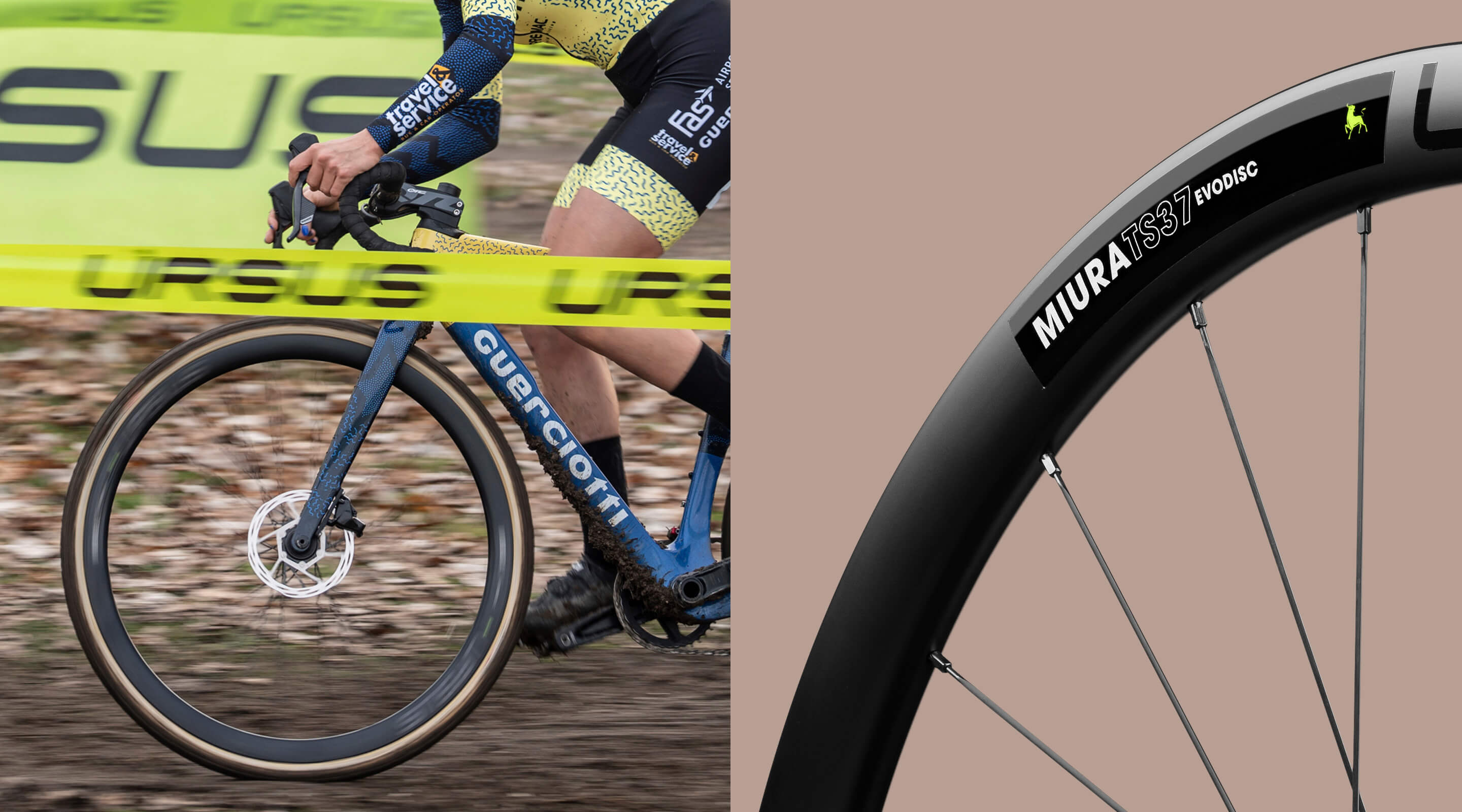
THE KEY WORDS FOR THE RIGHT BIKE? STIFFNESS, SMOOTHNESS, AND LIGHTNESS.
Cyclocross athletes compete in mud, along rough, steep trails. Two things are required: endurance and adaptability.
Maximizing your cardiovascular fitness and training your muscles isn't enough: to maximize your racing performance, you also need to choose the right components and accessories for your cyclocross bike.
WHAT WILL YOU FIND ON THIS PAGE?
WHAT IS CYCLOCROSS AND HOW IS IT DONE?
Cyclocross is a cycling discipline typically held in the fall and winter, during breaks from road racing. It is raced on short courses that alternate between asphalt and off-road, typically ranging in length from 2 to 5 km . Each race consists of several laps.
The duration of each competition is established by the jury based on the times taken to complete the first two laps; on average, the performance lasts about an hour.
Cyclocross courses are characterized by dirt, mud, ups and downs, and short stretches of paved roads. They often wind through woods or meadows, where artificial obstacles are built. For this reason , one of the key features of cyclocross is that athletes, for some stretches, lift their bikes and run on foot.
Want to become a good cyclocross racer? Remember that the winner is the one who can best adapt to the sudden changes in the terrain , but physical strength and endurance are also essential to compete in this sport that requires focus, stamina, and legs.

THE STORY
Cyclocross originated in the early 1900s as a training method for road cyclists during the winter season, when competitions were suspended. Cycling and running on muddy, bumpy trails gave athletes improved cardiovascular performance and strengthened their muscles. Some roadies continue to practice cyclocross today to keep them active during the off-season.
Over the years, cyclocross has become a discipline in its own right, practiced even by professional athletes, who dedicate themselves solely to this sport.
France is considered the birthplace of cyclo-cross because the first official competitions were held there in 1902. The discipline quickly became popular in Europe, especially in Benelux and Switzerland. Cyclo-cross also has a well-established tradition in Italy and Spain.
However, cyclo-cross had to wait until the mid-1920s, when the first race with international athletes was held in Paris, to become a fully-fledged international sport.
It wasn't until the 1940s that globally agreed-upon rules for cyclo-cross were established, and the first World Championships were held in 1950. Today, international races are held under the auspices of the International Cycling Union (UCI).
Since the 1970s, cyclocross has also spread to the USA, although even today the tradition is more deeply rooted in France, Belgium and Luxembourg than in the rest of the world.

THE MOST IMPORTANT RACES
Some races are true milestones in cyclocross. Below, we'll give you a brief overview of the main international competitions.
The World Cyclo-Cross Championships
The Cyclo-cross World Championships have been held since 1950. The first edition—open only to male athletes—was won by Jean Robic . Athletes represent their respective nations. The World Championships are held as a single, one-day race, and the winner becomes World Champion.
The categories in play are the following:
- Elite men and women
- Under-23 women's and men's
- Junior men and women;
- Mixed relay.
The reigning champions from the 2021-22 edition:
- Elite Men: Thomas Pidcock, United Kingdom
- Men Under-23: Joran Wyseure, Belgium
- Junior Men: Jan Christen, Switzerland
- Elite Women: Marianne Vos, Netherlands
- Women's Under-23: Puck Pieterse, Netherlands
- Junior Women: Zoe Backstedt, United Kingdom.
Cyclocross World Cup
The Cyclocross World Cup is a team race, taking place over multiple stages in various participating countries throughout the autumn and winter period, generally from October to January. The current edition, in 2022-23, includes 14 stages across the United States and Europe.
In Italy, the stage has been hosted in Val di Sole in recent years, in the evocative setting of the Alpine winter.
Superprestige
The Superprestige is another stage competition held in Belgium and the Netherlands, with both men's and women's Open and Junior events.
The first Superprestige races were held in 1982, and the event has been held annually since. It consists of eight stages, each of which is assigned a score that counts towards the final standings.
Like the world championship, the Superprestige is also organised under the auspices of the UCI.
X2O Badkamers Trofee
Another fundamental race in the world of cyclocross is the X20 Badkamers Trofee , also held in Belgium, between October and February.
There are 4 categories in the competition:
- Elite Men;
- Men Under 23;
- Elite Women;
- Junior Women.
Again, the event is sponsored by the International Cycling Union.
ESSENTIAL ACCESSORIES FOR THE CYCLOCROSS ATHLETE
Have you decided to get on your bike and take up cyclocross? You'll need legs, stamina, and perseverance , as well as appropriate clothing and accessories that enhance your dedication.
Let's start with the clothing. Cyclocross athletes wear a suit very similar to those used in time trials, although the speed in cyclocross is significantly slower. The choice instead depends on the fact that this particular suit allows the athlete to move freely, having to dismount and mount the bike very frequently.
As for shoes, MTB shoes are used. We suggest you pay attention to these details: the release system and the cleat.
An automatic engagement/release system is essential for quickly getting off the bike to run over obstacles, hills, mud, stairs, etc. For this reason, shoes must have a metal plate and not a plastic one like in road cycling.
For your safety, you should always wear a helmet. Typically, cyclocross riders use a classic helmet, similar to those used for road cycling. This type of helmet offers a good balance between lightness and protection and can be equipped with a short visor for sun protection.
Finally, among the essential components for cyclocross are those for the bicycle, which can change the outcome of your race . First of all, fit wheels suitable for tackling rough terrain and mud, but without weighing down the bike, which you'll have to carry on your shoulders during the race.

THE BENEFITS FOR THE PHYSICAL BODY
Why would you do such a strenuous sport?
Besides being fun and pushing your mind to its limits, cyclocross also offers great physical benefits, especially in terms of cardiovascular fitness and muscle strengthening.
The uneven terrain, the constant changes in pace, and the rapid succession of climbs and descents force you to vary your pedaling force and heart rate rapidly and seamlessly. Since races typically last less than an hour, cyclocross is a perfect cross-training option for improving cardiovascular performance . Like all endurance sports, it also increases your oxygen consumption capacity (VO2MAX) through lung work.
Even from a muscular strength perspective, the non-linear terrain causes you to experience extra fatigue, which over time translates into extra power and endurance . The pedaling is almost never aligned, so you'll need to keep your leg, back, and core muscles under tension and contracted throughout the race.
During the running phase, with the bike lifted on your shoulder, you'll notice that the muscles in your upper limbs and back are also working extra hard. If you've prepared your body for this strenuous workout, you'll reap significant benefits in terms of muscle strengthening .
Obviously, however, to be able to conduct a cyclocross race without physical trauma you must first follow constant, gradual and specific training.
HOW TO TRAIN FOR CYCLOCROSS
Cyclocross training should be aimed at enabling you to tackle an entire race above your lactic acid threshold. This is the "lactic acid production" threshold beyond which the body can no longer metabolize this muscle waste product. Lactic acid buildup causes fatigue, pain, and prompts you to stop and rest.
CX is a tough discipline that tires out your muscles. However, with good athletic preparation, you can raise your lactic acid threshold and achieve better performance in terms of both muscular endurance and cardiovascular fitness . If you decide to embark on this journey, you are someone who loves a challenge and knows how to put yourself out there.
If you're starting from scratch, cyclocross training should include three progressive steps:
- The basics of physical, muscular and cardiovascular preparation for cyclocross;
- Reinforcement and enhancement;
- Specialization for the type of physical work required during cyclocross racing.
The most effective types of training are:
- Endurance training, with high gears and few pedal strokes, simulates the difficulties encountered in progressing on muddy and steep trails. These can be done with intensity peaks and intervals or with pyramid-style repetitions followed by a cool-down phase;
- Cross-training , alternating cycling with running, swimming, or gym sessions, or simulating running with a bike on your shoulder, as happens in a race. Aerobic sessions with recovery intervals are also very important;
- Technical training, because the type of terrain requires agility and skill on the bike.
Your weekly plan should include about four workouts, alternating work days and rest days. It's always best to have an experienced physical trainer guide you, given the intensity of the physical work required by cyclocross.

CYCLOCROSS, MTB XC, OR GRAVEL? THE DIFFERENCES
If you are just approaching the world of cyclocross for the first time, you may not yet be entirely clear about the differences with other disciplines such as mountain bike cross country (MTB XC) and gravel.
MTB XC takes place on circular race courses that can be up to 10km long, often specifically constructed to create a track with obstacles, branches, leaves, jumps, and tight turns. Races are usually longer than cyclocross races, lasting about two hours. Mountain bikers maintain a fairly high speed throughout the race and tackle highly technical single tracks within the circuit, where technique and responsiveness are paramount.
Gravel biking, on the other hand, is a very recent discipline that has seen a real boom in recent years. The term can be translated into Italian as "gravel." Indeed, gravel trails often run on dirt roads and are long, or very long, itineraries. It's not uncommon, for example, for gravel bikes to also be used as touring bikes by cycling enthusiasts.
Cyclocross, MTB XC, and gravel bikes and wheels are all different. Each is optimized to best showcase the characteristics of the discipline and the athletes' performance.
HOW THE CYCLOCROSS BIKE IS MADE
We now come to a series of more technical information, which will however be really useful to you as you start competing in cyclocross.
Your bike should optimize your performance in terms of speed, even on off-road trails. So, we're not talking about "comfortable" bikes, but rather high-performance ones , suited to braking and restarting, and which enhance your muscle power even when revving up.
The frame is usually traditional in shape. You need enough room to fit your arm and shoulder into the main triangle, allowing you to carry the bike during the walking sections (which is also why there's no bottle cage). The frame is typically made of lightweight, durable materials such as steel or carbon.
Never forget that a cyclocross bike must navigate muddy terrain and obstacles. Therefore, there must always be a safe space between the pedal and the ground, even when your leg is straight.
The seat stays and fork are spaced apart to prevent mud from settling on the wheel, impeding movement.
The rules allow you to choose the type of gear change (mechanical or electronic) and the type of brakes (disc, cantilever, caliper, or pad). The gears must allow you to change gear frequently, often with short, intense pedal strokes. For this reason, many athletes prefer a progressive gear system.

HOW TO CHOOSE CYCLOCROSS WHEELS
The characteristics of cyclocross wheels permitted in competition are regulated internationally, but you have some choice.
It's helpful to learn from those who compete at the highest levels of cyclocross. Professionals prefer 37mm rims, medium-low profile, carbon, and tubular or—increasingly—tubeless tires. Disc brake -compatible wheels are also increasingly popular, as they're becoming the standard in pro cyclocross racing.
Carbon and aluminum are ideal materials because they are lightweight: a heavy bike will take longer to complete, especially when carrying the bike.
The wheels of your bike can change the entire setup of the race. A peculiarity of cyclocross is that the bike doesn't have suspension, despite the course often being bumpy and alternating between paved and muddy sections.
Many athletes prefer to use rigid wheels: by sacrificing comfort you can have a more responsive and high-performance bike during the race.
The choice of hubs is also important to maximize pedaling performance, without wasting energy: the goal must be to achieve maximum smoothness of the wheel, to race at speed even in the presence of mud, leaves, or dirt.
For more information: "Cyclocross Bike Wheels: How to Choose the Best Ones?"
URSUS CYCLOCROSS WHEELS
There are many options available on the market, but fitting quality wheels can make or break your race. With the right wheel, you have the chance to optimize your effort and reduce energy expenditure, without wasting a single watt of energy during the race .
URSUS produces technologically advanced wheels, designed to best enhance the characteristics of the cyclocross bike throughout the race.
Each URSUS wheel is developed by the internal research and development department and is subjected to progressive stress tests, both in the laboratory and on the track by professional cyclocross athletes.