

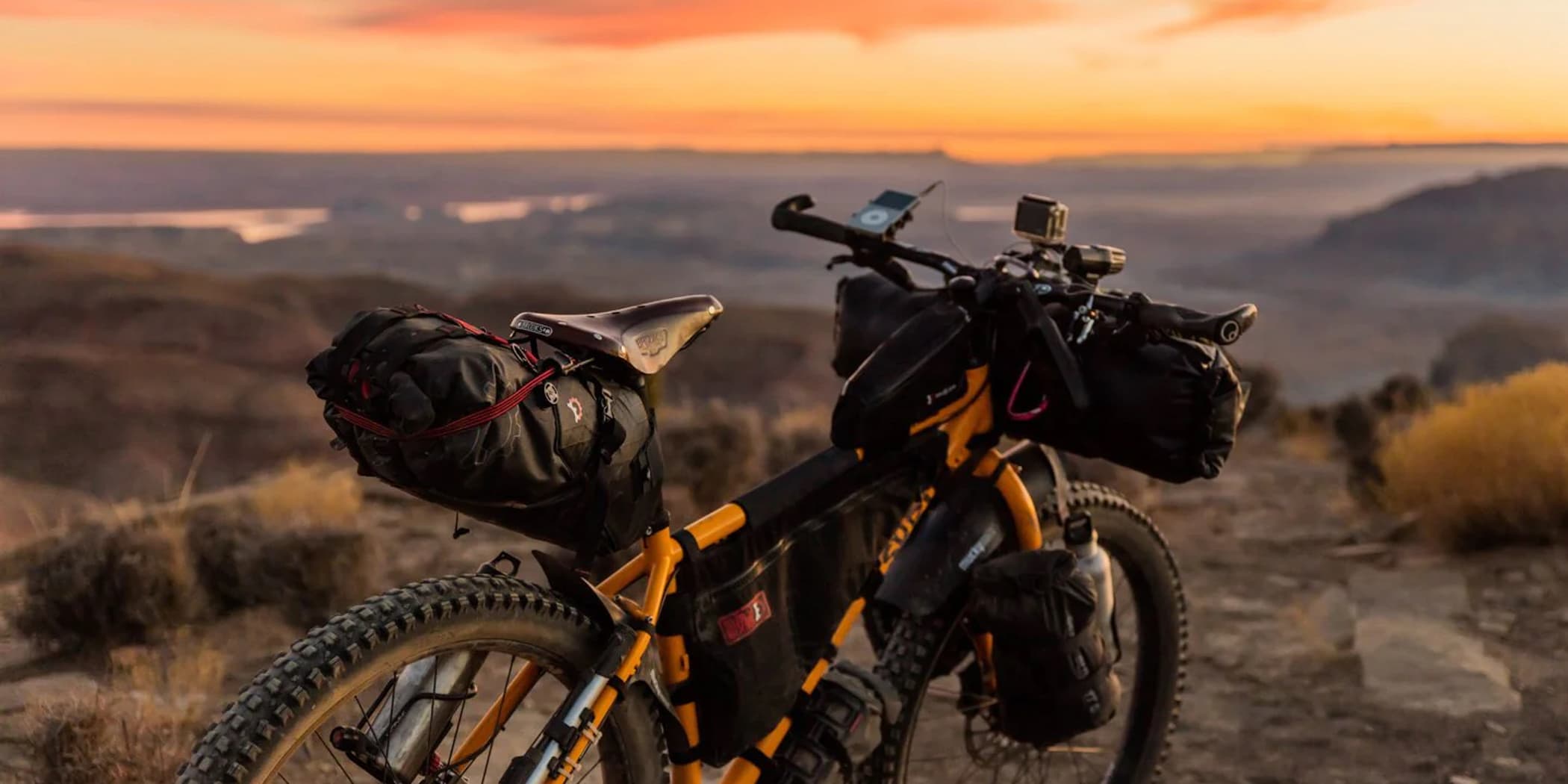
Mountain biking on mountains, mud, sand, and off-road. The wildest trails are accessible, and your vacation becomes a true two-wheeled adventure .
Although the most popular bikes for cycle touring are gravel and trekking bikes, if you're planning an off-road trip , a mountain bike can give you much more excitement because you can ride on any type of trail.
You just need to pay attention to the right accessories and equipment to make your trip comfortable.
Is mountain biking suitable for cycle touring?
Mountain biking can transform the way you travel. Cycle touring is rapidly growing, but, as we've said, there's a trend toward gravel bikes, road bikes, and trekking bikes. The choice is well-founded: comfort, rack space, and a more comfortable saddle. They're the perfect choice for long rides, without significant ups and downs or steep slopes.
However, if you decide to properly equip your mountain bike for travel , you'll discover a new way to experience cycle touring. The MTB allows you to move freely over the roughest terrain and you're no longer tied to bike paths, cycle lanes, etc.
Gravel, forests, singletrack, grassy surfaces: it doesn't matter whether you decide to ride through the Tabernas Desert in Andalusia, climb the Alps, or explore some of the great American parks. Thanks to a mountain bike, you can ride on both paved roads and technical terrain.
Will it be uncomfortable? Not if you choose the right accessories and equipment (more on that in a moment).
Pros and Cons of Mountain Bike Travel
If many people choose to travel on Gravel, Road or Trekking bikes there are valid reasons:
- they are lighter bikes (with the same construction material);
- not having suspensions, they require less maintenance;
- on flat surfaces they require less effort when pedalling and the rolling resistance is lower;
- They usually have devices to accommodate the roof rack.
However, even if you lose a bit in terms of comfort, the MTB gives you a series of advantages for cycle touring compared to road or trekking bikes:
- the bike is more robust and resistant;
- the riding position is more upright;
- going uphill, pedaling requires less effort;
- you have more control over braking;
- the bike is more cushioned, thanks to the suspension.
Furthermore, as we mentioned, with the right equipment and accessories, you can best adapt your MTB for an adventurous trip. The choice depends on the type of itinerary you plan to take.
5 tips for your mountain bike trip
- Choose the right MTB itineraries
Traveling by bike means pedaling for many kilometers, on various types of terrain and surfaces. If you've decided to embark on this adventure, we suggest choosing routes that you can include in your travel itinerary.
For travel, you'll need to adapt your wheels and accessories a bit, and carry some luggage. Carefully select MTB routes that you can handle despite these adjustments . Online, you can find many MTB routes with downloadable GPS maps, providing a wealth of details about the terrain, slopes, ups and downs, etc.
A second option is to travel by car and take your mountain bike with you, using it exclusively on designated outings. This is undoubtedly a more convenient option, but it takes away a bit of the adventure from the trip.
If, on the other hand, you plan to ride for a long time on flat dirt roads but without particular ups and downs and obstacles, then consider starting with a gravel bike without sacrificing comfort. - Bikepacking: Which parts of the bicycle to use and how
One limitation of MTBs for cycle touring is that they usually don't have rack space. However, you can bikepack with special bags, which can be attached to strategic parts of the bike.
You can in fact use:
- Saddlebags. For this reason, we recommend using front suspension , unless you plan to ride on particularly difficult terrain where you may need full suspension, with specific rear wheel cushioning. In this case, make sure the saddlebag is sized correctly and doesn't interfere with the rear wheel's rotation;
- frame bags, which attach to the MTB tube;
- handlebar bags (but first check that your disc brake hoses allow you to mount them correctly);
- hydration backpack.
These bags are made of waterproof fabrics. They come in various sizes, allowing you to better organize your gear, even depending on the length of your trip. The golden rule is: travel light and bring only the bare essentials.
- The mountain bike accessories you absolutely must bring with you
As for clothing, bring a couple of changes of technical clothing, a change of underwear, and perhaps some suitable clothes for a night out in the city, to enjoy a well-deserved dinner at a local restaurant. Don't overdo the amount of clothing ; instead, pack some Marseille soap to wash used clothes and always have a fresh change of clothes. If your trip involves sleeping in a tent, choose a solution that minimizes bulk and can be carried as easily as possible in your handlebar bag.
The really important things to have with you are:
- water and energy bars;
- cash and documents;
- MTB repair kit;
- helmet.
Don't leave without checking that you have these things with you! - Tips for best equipping your wheels
Choosing the right wheels for mountain biking is very important. The first piece of advice, a bit obvious, is to opt for tubeless tires to reduce the risk of cuts and punctures, but also because they're more adaptable to different types of terrain.
Of course, we also recommend using wheels that are compatible with disc brakes.
As for the tread, the decision here may depend on the type of route you intend to ride. If you don't need a tire with deep knobs that produce a lot of friction (useful on very challenging sections, for example), we suggest choosing a tread with shallower but denser knobs. This is a more versatile choice for traveling.
Possibly. Then, choose a harder, more wear-resistant compound.
Before leaving, don't forget to check these essential things:
- the tension of the spokes;
- the health of the hubs and especially of the ball bearings inside;
- the wear condition of the brake pads.
- The finishing touches: the saddle and the handlebar stem
Your MTB bike is ready for the ride, but you can still make some finishing touches to make it more comfortable.
The first concerns the saddle. Mountain bike saddles are inherently comfortable because they have good suspension and are made of materials that absorb shock. However, they have a particular forward inclination, allowing for out-of-the-saddle pedaling on technical sections. While this solution is particularly practical for outings and races, it can be uncomfortable over long journeys.
You can optimize your riding position by using a rigid seatpost to find a more comfortable position and/or by replacing your mountain bike saddle with a specific touring saddle.
The other comfort factor is the handlebar stem . Generally, the MTB position is more upright than the road position, but some athletes choose an aggressive bike setup to pick up speed on descents, for example in endurance races.
If you are one of those, we suggest you change your travel setup.
By using a stem with an adjustable alpha angle, such as the Magnus S700 model from Ursus , you will have a posture that is as suitable as possible for your biometric measurements when riding your MTB.


