

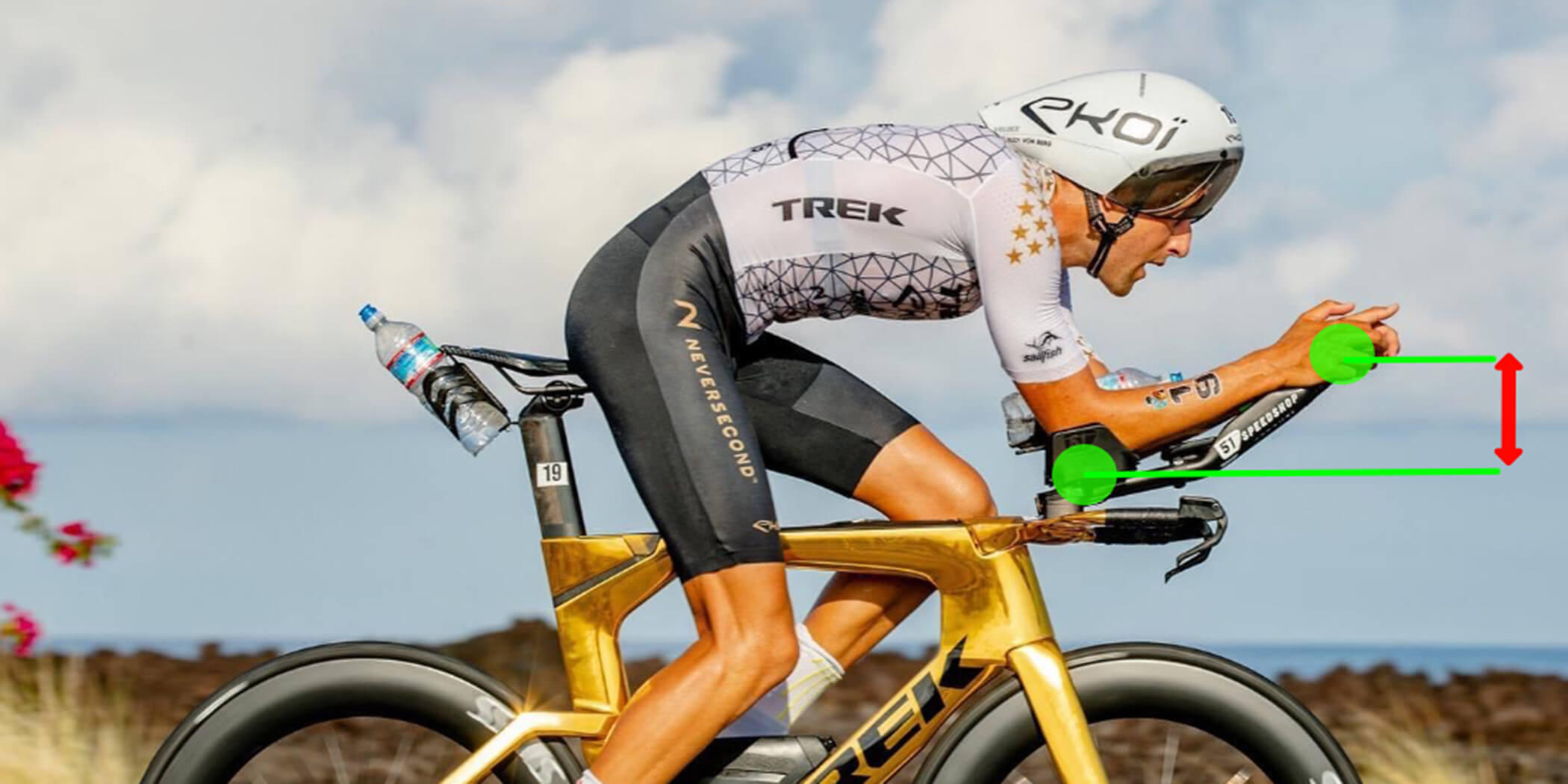
The posture in the saddle during the cycling portion of a triathlon is quite unique. This is because triathlon is a sport unlike any other cycling discipline.
In fact, athletes come to cycling already tested by the swimming section and then also have to face the race.
In Triathlon, correct posture on the bike is therefore fundamental for two reasons:
- reduce the physical load on the athlete, optimizing physiological movements;
- increase performance by improving aerodynamics.
The UCI triathlon regulations are very restrictive regarding the use of handlebar extensions, which can promote a more relaxed or aerodynamic posture. These rules are no longer applicable in Ironman, for example.
So every race is a universe unto itself, but there are some general tips to follow to maintain correct posture on the triathlon bike.
Correct posture on a racing bike vs. a triathlon bike
Here are some differences between the posture on a road bike and a triathlon bike:
- In triathlon the saddle is lower to reduce muscular strain, especially on the calves, given that the athlete then has to run on foot;
- The torso angle is more closed in Triathlon, with a forward weight balance : this helps to make pedalling aerodynamic, but also to better manage braking;
- The weight is placed on the handlebar extensions , when it is possible to use them for the Triathlon bike: this reduces the involvement of the neck and arm muscles compared to the racing bike;
- Triathlon athletes rest on the nose of the saddle, with their knee in line with the pedal spindle , because this helps to add more power to the pedal stroke.
Accessories for maintaining the correct posture in the saddle
When regulations allow it, triathletes use very effective accessories to maintain correct posture in the saddle.
The first magical object is the crankset . As physics teaches, a longer crankset is a more advantageous lever for the athlete, who can reach greater speed with less effort.
Then there are the handlebar extensions : these are structures that attach to the handlebars and allow the triathlete to shift their weight forward, possibly even resting on their elbows.
In Ironman, very advanced postures are often seen , with the hands positioned higher than the shoulders (a riding position known as the mantis , because it resembles the praying mantis). This posture reduces the overload on the neck muscles, but the height of the hands must be carefully considered to avoid penalizing aerodynamics.
Last but not least: the handlebar itself is fundamental for the posture on the bike
To maintain a correct position in the saddle, the handlebars must be ergonomic, optimized for the athlete's physiology, but also for aerodynamic performance. In short , the athlete must be comfortable, free to move without causing injury or joint problems, but must also develop power and cut through the air.
To make an accessory of this type you need to have:
- a decidedly in-depth study of ergonomics
- an understanding of the dynamics of triathlon
- skills in physics and aerodynamics
- knowledge of the most innovative materials.
URSUS handlebars suitable for triathlon have it all. They are developed thanks to the feedback of professional and amateur triathletes , which helps us constantly improve our products.
Customization and ergonomics are key to our work in designing and manufacturing handlebars and accessories for triathlon bikes. Only an athlete who maintains correct posture in the saddle can pedal hard and for long.


