

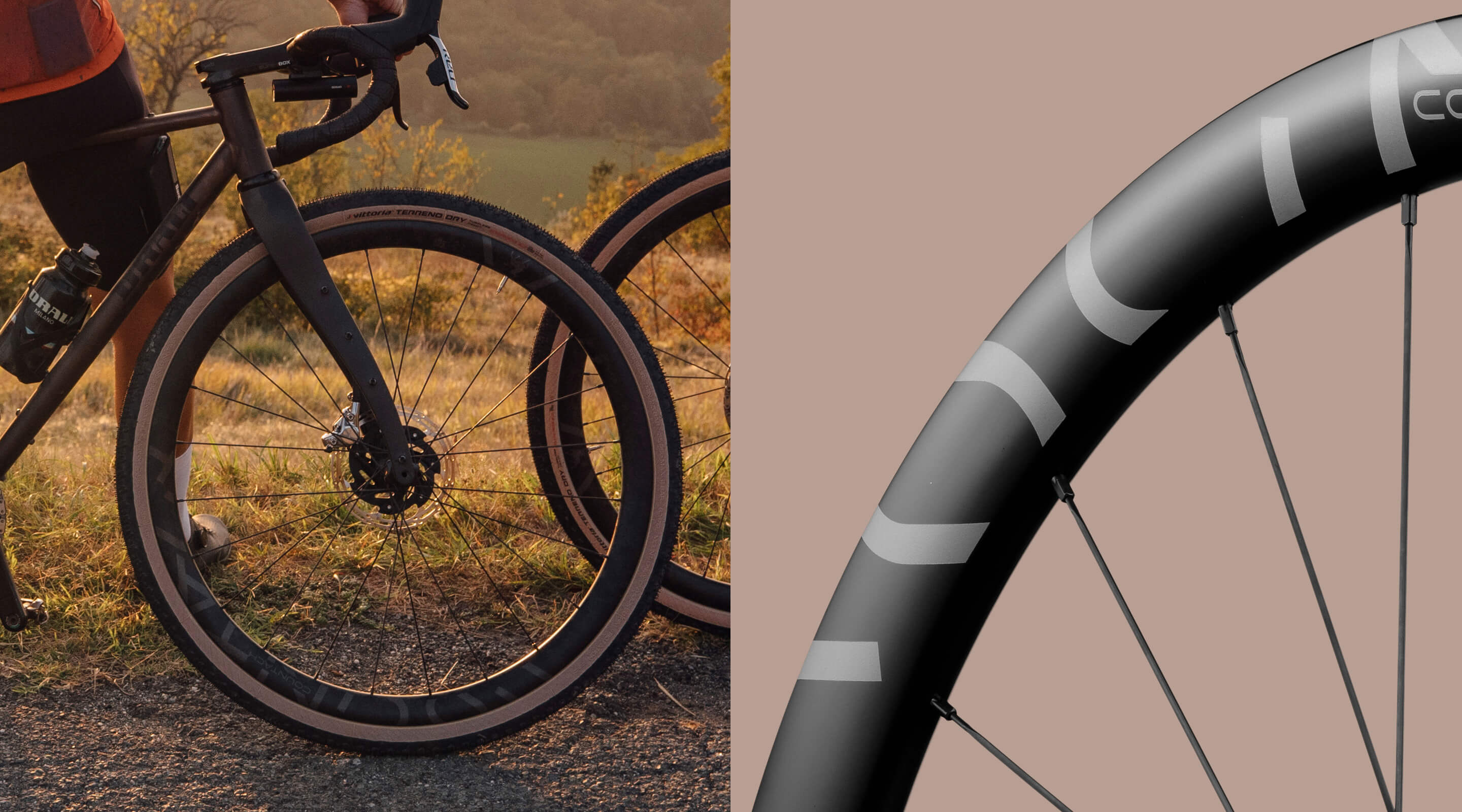
GRAVEL BIKE WHEELS: DON'T LIMIT YOURSELF TO ASPHALT!
Cycling is freedom: so why remain confined to paved roads?
Ursus Gravel wheels are here to change the way you ride.
Experience a truly transversal driving experience.
WHAT WILL YOU FIND ON THIS PAGE?
- GRAVEL: DEFINITION AND ORIGIN
- TRENDS IN THE DISCIPLINE
- THE MOST BEAUTIFUL RACES AND EVENTS DEDICATED TO THE GRAVEL DISCIPLINE
- THE MOST BEAUTIFUL ROUTES IN ITALY
- HOW TO BEST PLAN A TRIP
- HOW ARE GRAVEL BIKE WHEELS MADE?
- DIFFERENCE BETWEEN CYCLOCROSS AND GRAVEL WHEELS
- DIFFERENCE BETWEEN RACING AND GRAVEL WHEELS
- Aluminum or Carbon? Pros and Cons of Different Materials
- GRAVEL BIKE WHAT ARE THE MOST IMPORTANT NEEDS?
- THE ACCESSORIES THAT CANNOT BE MISSING ON YOUR GRAVEL BIKE
- HOW TO CLEAN YOUR GRAVEL BIKE AND WHEELS
- URSUS MIURA TC37: PERFORMANCE AND ELEGANCE FOR YOUR GRAVEL BIKE
- TUBULARS FOR GRAVEL BIKES? HERE ARE THE MIURA TR37
- URSUS ORION: MAXIMUM COMFORT FOR YOUR ADVENTURES
GRAVEL: DEFINITION AND ORIGIN
Gravel. An English word that refers to terrain that has nothing to do with asphalt: small stones, gravel, country roads frequented at most by a few lazy farm vehicles.
Gravel cycling and gravel bikes aren't just a simple trend, a fad that's grown rapidly in less than ten years. Gravel is a return to the past thanks to modern technology. Gravel has been and will forever be the roads of heroic cycling since the early decades of the 20th century. Gravel was already the 1910 Milan-San Remo: mud, snow, and ice. Seventy-one at the start, three at the finish. Gravel was already the 1913 Tour de France. That of the first yellow jersey in history, Eugène Christophe, who fell on the descent of the Tourmalet and was forced to repair the fork of his Peugeot alone in a blacksmith's shop. Gravel is the life of cycling, regenerating itself to find new forms and inspiration.
It was 2006 when Jim Cummins and Joel Dyke decided to organize a 200-mile off-road ride—Dirty Kanza—to admire the beauty of the Flint Hills area of Kansas, USA. Thirty-four riders took part. Today, that race no longer exists, or rather, it has changed its name. Sponsors have arrived, professional cyclists have joined, and enthusiasts at the starting line have swelled to over 4,000. But gravel is and always remains an alternative way to reconnect with cycling's soul: a life experience that only thrives when shared.
TRENDS IN THE DISCIPLINE
Gravel Bikes: Trend or Revolution? The phenomenon sparked by gravel bikes resonates, first and foremost, with a healthy dose of values. Freedom, a carefree attitude, an escape from the stresses of everyday life to breathe a few breaths of fresh air, far from the dangers of traffic. Of course, here too, we're starting to hear about competitions, races, and prize schemes, but without forgetting that what matters is the philosophy, the way you approach cycling. If cycling is your passion, gravel will make you feel at home anywhere, even on trails that until recently were exclusively reserved for cross-country mountain biking.
Looking to spend a unique weekend with friends or reach the North Cape alone? You can carry everything you need on your bike with special accessories that allow you to travel completely independently.
This trend is called bikepacking , and it's a style that has given rise to real communities of cycle travelers. No rankings, no high performance. A beer and an aperitif featuring local products you've just discovered can be a welcome prelude to a night spent at high altitude or in the woods, around the fire before a well-deserved rest in the tent.

THE MOST BEAUTIFUL RACES AND EVENTS DEDICATED TO THE GRAVEL DISCIPLINE
Gravel bike competitions and festivals are on the rise and are finding their own identity. The words "challenge," "series," "race," and "classic" often accompany the names of the venues hosting these events.
Somewhere between a new trend and an established phenomenon. A push—long-awaited by some—to regulate gravel-only races and cycling rallies could come from the International Cycling Union (UCI). Its president has openly stated that: "Gravel has been part of cycling's DNA since the very beginning." To this end, the UCI is working on a "world series" dedicated to the discipline and the UCI World Championships: it's no coincidence that gravel sections have returned to the Giro d'Italia and the Tour de France.
Despite the difficult institutional recognition, the movement is growing thanks to that "gravel appetite" that comes particularly from the United States. If you want to experience the true essence of gravel, then all you have to do is sign up for Garmin Unbound Gravel, the event that sparked its global success in 2006. Looking at the US calendar, the list can be truly long, and you might be spoiled for choice: Crusher in the Tushar, SBT GRVL, Vermont Overland, Grinduro, Lost and Found...
As for Europe, Belgium was the first "importer" of the gravel format. While the Schaal Sels is reserved for professionals, the Dirty Boar is worth attending if only for the final party featuring beer and "fritjes," the famous Belgian fries. In Great Britain, there's the Grinduro and the Dirty Reiver 200. In Germany, it's worth mentioning the Gravel Rallye Series—with two stages between the Black Forest and the Rhine Valley—and the Gravel Marathon Salzkammergut Trophy in Austria.
Italy is also no slouch with its Gravel Road Series, which includes three races, including the Nova Eroica. The calendar also features numerous non-competitive, unsupported events dedicated to bikepacking, with only GPS tracking provided. There's no time limit, and you're free to get lost and admire the beauty of nature: Tuscany Trail, Veneto Gravel, and La Monsterrato-Strade Bianche. Speaking of Strade Bianche, here's the story of Giulio , a friend of Ursus, who rode the route of the Siena classic for professionals, which has become a fixture of the international cycling season.
If you want to sit under the stars and share experiences with other gravel bikers and more, you can't miss BAM! Campfire, Europe's first gathering of cycle tourists.
THE MOST BEAUTIFUL ROUTES IN ITALY
Italy is a land of cycling and attracts enthusiasts from all over the globe: the climate, the artistic beauty, the fine wine combined with a unique gastronomic culture. A gravel bike can be the ideal "seasoning" to combine all these elements. From north to south, Italy offers the opportunity to experience a "dense" territory where it's rare to find meters without history. An example?
90 km, five medieval towns, vineyards, and sites of the Great War. Departing from Cittadella, we head towards Castelfranco Veneto, then quickly ascend to Asolo—one of the most beautiful villages in Italy—and then on to Bassano del Grappa and then Marostica, the city of cherries and chess, before returning to Cittadella.
If you'd like to continue exploring this area, the Asiago Sette Comuni Plateau offers the opportunity to experience the sites of the Great War on foot, thanks to 500 km of dirt roads. These places still yield historical relics today: Mount Cengio with the famous "Salto del Granatiere" (Granatiere Jump), Cima Ekar—where the Campagnolo gravel drivetrain of the same name was born—all the way to Mount Cogolin. Military roads, farmhouses, mountain huts, dairies, and mid-mountain pastures.
We apologize to the other Italian regions, each of which deserves a long paragraph dedicated to the topic. To make up for this, here are some of the most beautiful routes in Italy .
HOW TO BEST PLAN A TRIP
Bikepacking or a two-hour Saturday morning ride to kick off the weekend? Regardless of your fitness level or expectations, dedicating some time to researching the route you'll be taking is essential. Knowing the routes, elevation changes, points of interest, and whether or not there are services along the way is crucial and helps you deal with unexpected events.
Planning a ride effectively means trying to predict what will happen above and below your wheels. Terrain, mapping, and weather are key factors in unlocking many choices. "How and how much should I wear?", "Are there any fountains along the route?", "What will the off-road conditions be like?" are just some of the questions you'll need to answer before embarking on a gravel bike ride, especially if you're unfamiliar with the terrain.
Garmin and Strava aren't just activity tracking platforms that answer the question "what kind of cyclist are you?" Strava, for example, lets you choose your road surface preferences while simultaneously displaying your start and finish points. Garmin allows for a three-dimensional study of a territory with the ability to transfer and synchronize all the data to a handlebar-mounted device. A valid compromise could also be Komoot, a platform that allows you to create and view gravel routes using points of interest (highlights) reported by users.
HOW ARE GRAVEL BIKE WHEELS MADE?
This question could be answered with a simple "it depends." The truth is that gravel opens the door to a much broader range of uses compared to a standard road bike. There are gravel bikes that can even accommodate 29" MTB wheels, so a solution could be found by asking another question: Gravel wheels: how to choose the best ones?
Warning: there's no absolute "best" wheel. Of course, we can play around with our personal tastes and experiences, but the "best" product is identified based on the type of terrain and our approach to gravel riding. If our goal is to ride a granfondo on the road without too much racing ambition tied to a GC, a pair of medium-profile carbon wheels—for example, 37mm—designed for tubeless/clincher setup can be a good compromise. Conversely, if we're oriented toward bikepacking and adventure, a slightly "softer" and more comfortable aluminum wheel is better: 25mm profile, 24mm internal width for tubeless/clincher setup. This setup allows for the installation of tires from 26 to 46mm. These are the main technical characteristics that reveal what a gravel wheel is made of.

DIFFERENCE BETWEEN CYCLOCROSS AND GRAVEL WHEELS
There's a fine line separating gravel wheels from those used in cyclocross. The line is defined by Article 1.3.018 of the UCI's written and approved guide to technical equipment.
In cyclocross, the frontal section of the tire, measured at both ends, cannot exceed 33 mm. Furthermore, cyclocross is a true competition, run on a defined circuit and lasting a maximum of one hour. Gravel doesn't necessarily have to be competitive. That's why companies offer rims with larger internal channels capable of accommodating tires that, in some cases, can even exceed the standard 46 mm. Cyclocross tires must also be free of studs or lugs.
A gravel bike, at the moment, doesn't have to meet UCI technical requirements. This means that tire cross-sections can become more significant, and tread characteristics can vary to the point of including metal lugs to provide grip that wouldn't be possible in cyclocross.
DIFFERENCE BETWEEN RACING AND GRAVEL WHEELS
Gravel is a true bridge between road and mountain biking, and vice versa. A middle ground where differences have been smoothed out with the introduction of some important technical solutions in the road segment: disc brakes and wider tires. Many brands offer the same product in their catalogs with a dual purpose. This is not a mistake: a good portion of the gravel segment derives from road bikes.
There are, however, differences: the rim's internal width can determine the tire width range that can be used during the build. A wheel with a 19mm internal width intended for tubeless/clincher setup can accommodate a tire from 23 to 40mm. The 24mm width used for both road and gravel, however, generally accommodates tires up to 46mm.
There's another variable to consider: aerodynamic drag. Numerous studies have established that it's this force that most detracts from a cyclist's performance, more so than weight. It's no coincidence that on the road, wheel profiles are higher, spokes can be flat, and the external design of rims can resemble the unmistakable design of a golf ball. Furthermore, especially in races with mechanical assistance, using tubular tires still makes sense, while this isn't practical for gravel. Replacing a tubular tire would be too laborious, not to mention the fact that it's always best to wait 24 hours after gluing before using it.

Aluminum or Carbon? Pros and Cons of Different Materials
Let's start by saying: they're both excellent materials. Stiffness, elasticity, weight, and cost are the three main differences. A good carbon wheel responds better to torsional forces than aluminum, which is a "softer" material that trades off lateral stiffness.
When the elevation gain starts to reach four figures, weight is another factor to consider. It's not 20-30 grams that determine performance. What's certain is that when the difference starts to settle between 200 and 500 grams and your rides are always climbing, another advantage of carbon fiber emerges. Furthermore, carbon fiber leaves ample scope for creative development. This means that the elastic modulus of the fibers along the entire surface of the rim can be optimized depending on the stresses received, both lateral and vertical. Unlike aluminum, which is extruded, a process that eliminates the possibility of engineering adjustments.
However, when it comes to price, there's a clear difference in terms of financial investment: this is why aluminum is used in mid- and low-end builds. Ultimately, elevation gain, type of road surface, and desired response from the bike are additional factors to consider when choosing.
GRAVEL BIKE WHAT ARE THE MOST IMPORTANT NEEDS?
Adventure or fast trails? Racing or relaxed pedaling? Often, needs also determine the intended use. The gravel range can be broken down into at least two segments that identify the different types of bicycles.
Backroad gravel bikes are derived from road bikes, using the same components. These products focus more on smoothness and speed, which comes at the cost of rougher dirt roads or singletrack, while adventure bikes eschew the race-derived performance to make way for different standards, such as 27.5" wheels, which make the bike more responsive and maneuverable in tight sections, and tires up to 50 mm wide.
In both cases, the provision for accessories to facilitate the transport of materials (for repairs, food, etc.) becomes an essential feature. Optimizing space is crucial, as are the frame and fork tolerances that determine compatibility with different tire sizes. Disc brakes and thru-axles are universal standards that simply cannot be done without.

THE ACCESSORIES THAT CANNOT BE MISSING ON YOUR GRAVEL BIKE
Let's start with the basics. The best accessories for your gravel bike are undoubtedly a good puncture repair kit, which you shouldn't leave home without!
If your wheels are clinchers, it's best to pack a couple of inner tubes. If your wheels are tubeless, you could also get a "fast" inflation and repair kit. A tire lever, pump, and perhaps a CO2 valve and a multitool can complete the kit.
Double water bottle. If you plan to spend more than a couple of hours in the saddle in remote and less traveled areas, this becomes essential. In addition to the standard 550 ml water bottles, there are 700/750 ml bottles available that can provide greater autonomy and water reserve.
A cycle computer capable of communicating with one or more satellite positioning systems becomes a valuable ally in staying on track. Furthermore, if properly set up, this system can help locate the cyclist even in an emergency.
Bags. Another topic dear to all bikepacking enthusiasts. Frame bags, saddle bags, and handlebar bags are the three most common accessories available on the market. For extreme storage needs, accessories for attaching to the fork and rear stays are available.
Signal lights become mandatory when cycling after sunset, just as braces or warning vests become mandatory when riding through tunnels.
HOW TO CLEAN YOUR GRAVEL BIKE AND WHEELS
It's always recommended to follow the manufacturer's instructions to avoid unpleasant damage and corrosion that can compromise the functionality and safety of the bike, as well as voiding the warranty. In general, it's best to clean it regularly, trying to remove most of the dirt after each ride. This is the first principle of the manual " How to Clean Your Gravel Bike ."
Particular attention should be paid to cleaning the wheels, hub, cassette, and brake discs. This not only ensures smooth operation but also ensures safe braking. Remember: cleaning extends the life of your bike.
URSUS MIURA TC37: PERFORMANCE AND ELEGANCE FOR YOUR GRAVEL BIKE
Looking for a lightweight wheel that performs on any terrain and gives your bike that aggressive look that stands out? The Ursus Miura TC37 disc is an all-round gravel wheel that performs at its best on any trail. The rim is made of unidirectional carbon fiber that meets the aerodynamic standards of the NACA 0027 profile. Ursus engineers have thus designed a rim with an aeronautical-derived "teardrop" section: fluid dynamic resistance and related turbulence are minimized, greatly enhancing rideability even in variable wind directions. This feature, combined with the 37 mm profile, guarantees rideability in all weather conditions: from road to gravel roads.
The Ursus Miura TC37 can be considered versatile wheels with performance in their blood: weight per pair 1,520g, Center Lock standard for disc housing, Sapim CX-Sprint straight-head carbon steel spokes, RD50 hubs in ergal 7075, compatibility with Shimano, Sram XDR, Campagnolo freehub bodies and high-smoothness SKF bearings with the option of requesting Ceramic Speed.
The 21 mm internal rim width allows for the installation of tires from 25 to 36 mm. This range allows for a wide range of tire combinations on the same wheel, depending on the terrain conditions.
TUBULARS FOR GRAVEL BIKES? HERE ARE THE MIURA TR37
They're the twin sisters of the TC37. Same purpose, same materials used for assembly, but with one difference: the rim is for tubular tires. Tubulars on a gravel bike? A possible solution. The Miura TR37 weighs 1,440 g: a saving of 80 g compared to the "TC" version, tubeless/clincher. The rim, with an external width of 28 mm and an internal channel of 21 mm, allows for the installation of tubular tires from 25 to 34 mm. Enthusiasts of the "closed tube" can thus benefit from a high-end, versatile product that can be used on the road, in cyclocross, and on gravel all at the same time, just with a few extra precautions.
URSUS ORION: MAXIMUM COMFORT FOR YOUR ADVENTURES
Is gravel riding first and foremost a pleasure, a way to connect with nature, unwind, and discover a territory from a different perspective? Then the Orion wheel is the ideal choice . Aluminum rim with a 25 mm profile for tubeless/clincher tires, Sapim Leader black J-bend spokes, RD30 aluminum hubs, compatibility with Shimano, Sram XDR, Campagnolo freehub bodies, and high-speed SKF bearings. The aluminum rim with a 19 mm internal width allows for the installation of tires from 24 to over 34 mm: a synergy that allows for a high level of comfort. Thanks to these features, the Ursus Orion wheels are a perfect and reliable ally when it comes to spending days in the saddle without rushing and worrying on all terrains.