

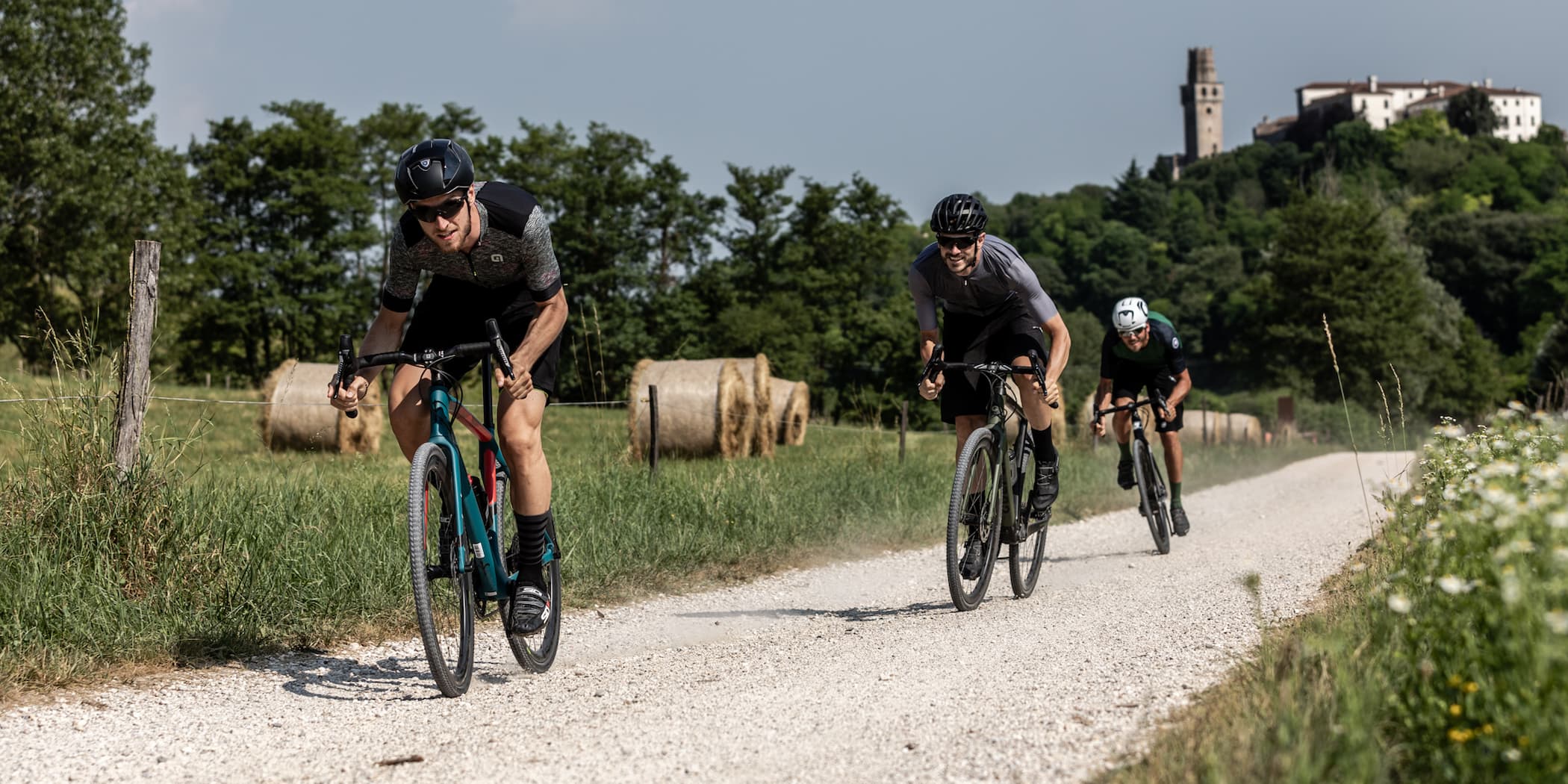
There's a new movement gaining traction among two-wheel enthusiasts: gravel biking. But what is gravel biking? Why is everyone talking about it? Is it a passing fad, or do these bikes truly meet the needs of users that justify their market launch? We'll try to clarify the issue in this article.
How did gravel bikes come about? What needs do they meet?
Think about the Eroica route, with its over 100 km of gravel roads. Imagine pedaling the 50 km of cobblestones of the Paris-Roubaix route. What bike would you trust?
Racing bikes? Mountain bikes? Cyclocross bikes? Trekking bikes? Well, as you might imagine, none of these bikes were designed for the specific conditions described above. Racing bikes were created to glide quickly on perfectly paved roads, mountain bikes accompany us on particularly rough trails, and trekking bikes are ideal for low-speed commutes, for carrying luggage, and for scenic excursions. And what about cyclocross? For this discipline, where athletes compete in close contact with mud, special bikes have been developed. They are extremely rigid like racing bikes, but with the addition of some typical MTB components, such as wide tires, thru-axle systems, and standard disc brakes.
Gravel bikes were created specifically to address this specific market segment. The public demanded a versatile bike, suitable for both paved roads and dirt roads or rougher terrain. This was a real need for many: the trend originates (as often happens) in the United States, where the pleasure of riding on dirt roads on a gravel bike is deeply rooted in everyday life. In the US, high maintenance costs have meant that almost all secondary roads are unpaved. This has led to a whole range of cyclists, tired of dealing with motorized traffic, migrating en masse to a more human-scale experience .

How are gravel bikes made?
Imagine a not-too-extreme, generally comfortable racing frame that's suitable for endurance riding. Grip on potentially muddy terrain is ensured by strictly 28" wheels ( find out which model we recommend ) with an internal channel that allows for the installation of wider tires (even 40 mm). A gravel bike's frame resembles a cyclocross frame, however its geometry is less suited to intense competition and more suited to long distances. The tubes are therefore less vertical, the rear triangle is longer, and above all, the bottom bracket shell is lower. Since (unlike with cross-country) you won't be jumping over obstacles with your gravel bike, this solution was adopted to give the bike a lower center of gravity, meaning greater stability.
The brakes on this type of bike are strictly disc brakes, allowing for powerful and precise braking even in muddy or wet conditions. Many gravel cyclists choose to mount randonneur handlebars for greater riding stability, without sacrificing the various hand positions that racing handlebars allow.
In conclusion
Gravel bikes: fad or revolution? You've probably realized that gravel bikes were designed for use on slightly rough roads, but their true value lies in offering the opportunity to have fun on paved roads as well. Be warned, you'll never find the performance you'd get with a racing bike, but you'll appreciate their more than satisfactory cruising speed on country roads or rough pavement, where road bikes suffer from potholes and bumps.
Remember: depending on how you intend to use your gravel bike, choosing the right wheels and tires will be important. Learn more about this topic in this post.
In short, we conclude by describing gravel bikes as truly versatile, abandoning the somewhat snobbish aura of latest-generation racing bikes to return to the roots of traditional cycling. Precisely for this reason, we believe, they're here to stay.


