

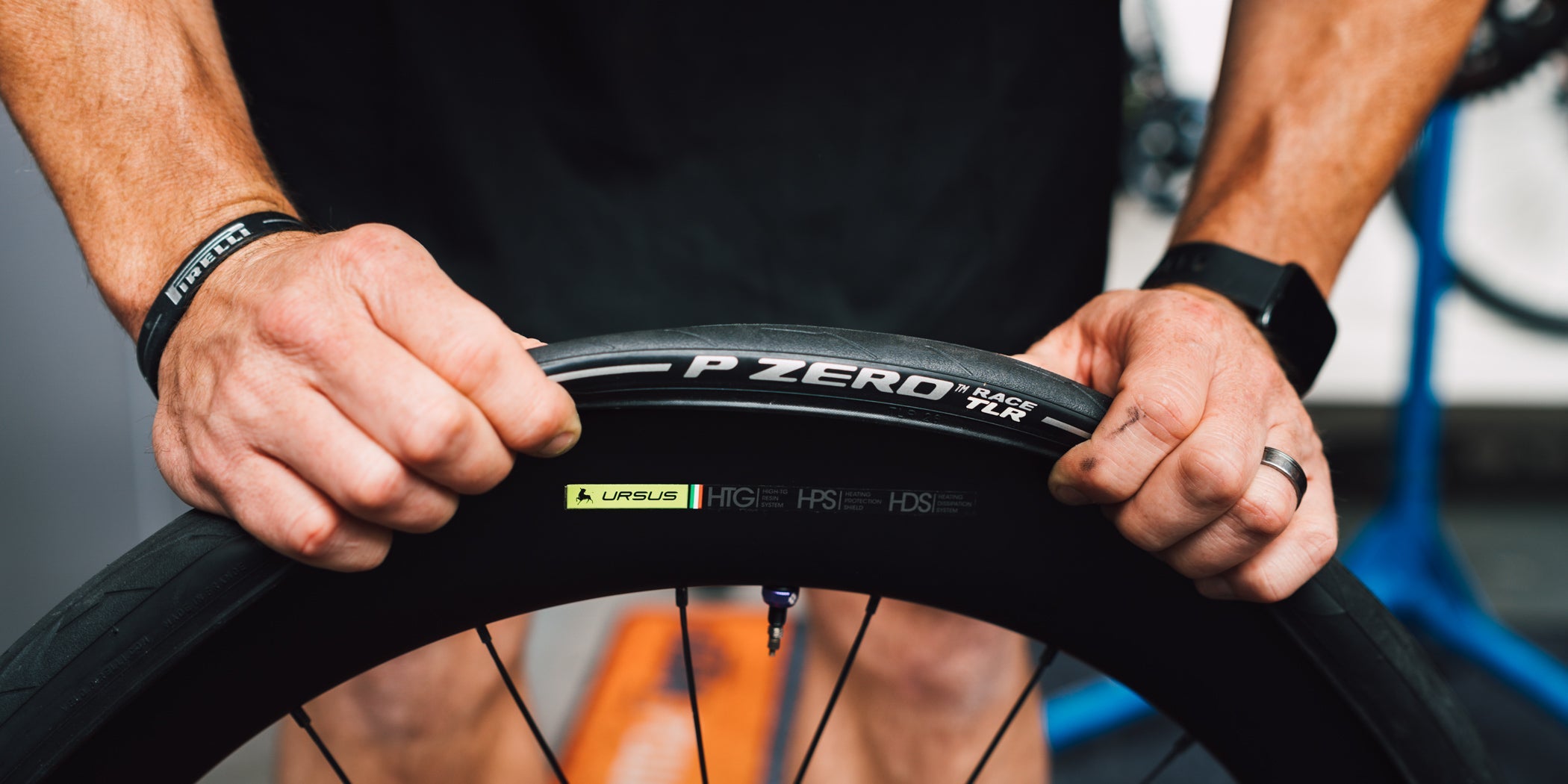
During its lifespan, each pair of carbon wheels is subjected to millions of continuous stresses. How do we ensure that the products we bring to market meet the most stringent safety standards? How do we verify their durability? The answer lies in our internal quality tests, which aim to simulate the maximum stress on Ursus wheels. Discover with us the methods and results of these true "trials by fire"!
Quality, our obsession
Quality is a fundamental aspect of Ursus. Each product is first designed and then manufactured to the highest quality standards, consistently certified by the main international ISO standards.
But how do we ensure this continues to happen? What are the most important steps that allow us to guarantee the supply of safe and durable mechanical cycling components? One of these is certainly the testing cycle conducted at the Ursus facilities in Rosà (Vicenza). Our internal tests aim to stress components to assess their durability. Resistance to wear.
We want to ensure we're bringing the highest quality wheels and components to market, which is why we design these tests to achieve extremely stringent standards. We're proud to say that Ursus standards currently far exceed the international standards required by the market.
Ursus tests: two distinct phases of quality verification
The tests we'll discuss are conducted in two distinct phases. The initial tests begin during the design phase of new products: all prototypes produced are subjected to rigorous endurance tests; only once these tests have been passed can the prototype begin to evolve into a product ready for mass production and subsequent commercialization.
After being released onto the market, all Ursus products continue to be tested. Each individual model is subject to random technical checks scheduled throughout the production period.
What kind of quality tests do we perform on Ursus wheels?
1. Rolling
A typical example of an internal test applied to our wheels? Let us tell you one: this test requires a wheel to rotate continuously for 360 hours. During this time, the wheel is subjected to a continuous series of mechanical shocks against two 10mm steps. The structural test involves a total of over 8 million impacts, withstood with a load of 95 kg. Keep in mind that the standard required by the international ISO 4210-5 norm only requires 1 million impacts withstood with a load of 70 kg. We can therefore confidently guarantee that all Ursus wheels are more than 8 times more impact resistant than required by the strict market regulations.
2. Rolling + Oscillation
To complement the previous test, a further test is performed. This test adds left and right oscillation to the wheel's rotation. During these movements, a series of impacts is applied using two 10mm steps, with a load of 95 kg. The test is conducted continuously for 180 hours: the wheel's complete integrity at the end of the test confirms its passing.
3. Static bending
We also test all our complete wheels for lateral stiffness, also known as static flex. To perform this test, the rim's deflection is measured by applying a 35 kg load. Essentially, the wheel is placed on a flat surface, and a load cell is attached to one side of the rim. The test requires the load, initially 35 kg, to remain attached to the rim for more than 1 minute. The load is then decreased to 25 kg and the test is repeated for more than 1 additional minute. The test concludes by removing the load from the rim and verifying that the lateral flexion experienced by the rim has not exceeded 1 mm. This test ensures that the wheel is rigid enough not to flex during normal use.
4. Rim overheating test
A specific test is performed on all carbon wheels to ensure that the rim structure (carbon fiber body and applied resin finish) is suitable for withstanding the high temperatures reached during braking.
During the test, the wheel is fixed to a control arm and rotated at 90 km/h. An operating force is then applied to the brake lever: this load must be high enough to allow us to obtain a constantly increasing braking force (in 20N increments) ranging from an initial value of 20N to a final value of 180N. For each increase in applied force, 3 tests are performed in 1 minute. Subsequently, the next braking force level is reached and the test is repeated.
This test is performed in both dry and wet conditions, allowing us to understand the actual braking values of Ursus wheels under all conditions of use. Here's a short comparison between the minimum data required by the ISO 4210 standard and the final results of this test on Ursus rims:
| Tire system | Braking force required by ISO 4210 | Final result on Ursus rims |
|---|---|---|
| TUBULAR in DRY conditions | 425 N | 744 N |
| TUBULAR in WET conditions | 220 N | 500 N |
| CLINCHER in DRY conditions | 425 N | 676 N |
| CLINCHER in WET conditions | 220 N | 472 N |
5. UCI Test
Ursus wheels are used every year by top professional cyclists to cover thousands of kilometers and participate in the toughest races. Our relationships with pro teams like Bardiani - CSF, Neri Sottoli - Selle Italia - KTM, and Torpado - Ursus are in themselves a path of excellence for Ursus, leading to constant improvements in the reliability and performance of our products. What we describe below is an additional test performed on every single wheel model with a rim profile of at least 24mm. This test serves both as a further confirmation of the rim's durability and to certify its suitability for use in all competitive events.
This test is essentially a sort of crash test: a 10 kg weight is dropped onto the wheel (without a tire). The test result is considered successful if the wheel shows no deformation or lateral slippage greater than 1 mm. You can check for yourself which wheels are suitable; all wheel models that pass this test are listed on the official UCI website.
The Ursus products currently approved by the UCI are:
-
Miura T37
-
Miura TS37
-
Miura C37
-
Miura C50
-
Miura TS87
-
Miura TS37 Evo Disc
-
Miura TS47 Evo Disc
-
Miura C58
-
Miura T45
-
Miura TS58
-
Miura TS90
-
Miura CB38
-
Miura T47
-
Miura TS47
Collaboration with professional teams, given the extreme use to which the product is subjected, not only pushes us to increase reliability in terms of performance but also to improve aspects related to ease of use, for example facilitating quick wheel replacement or simplifying transport methods.


