

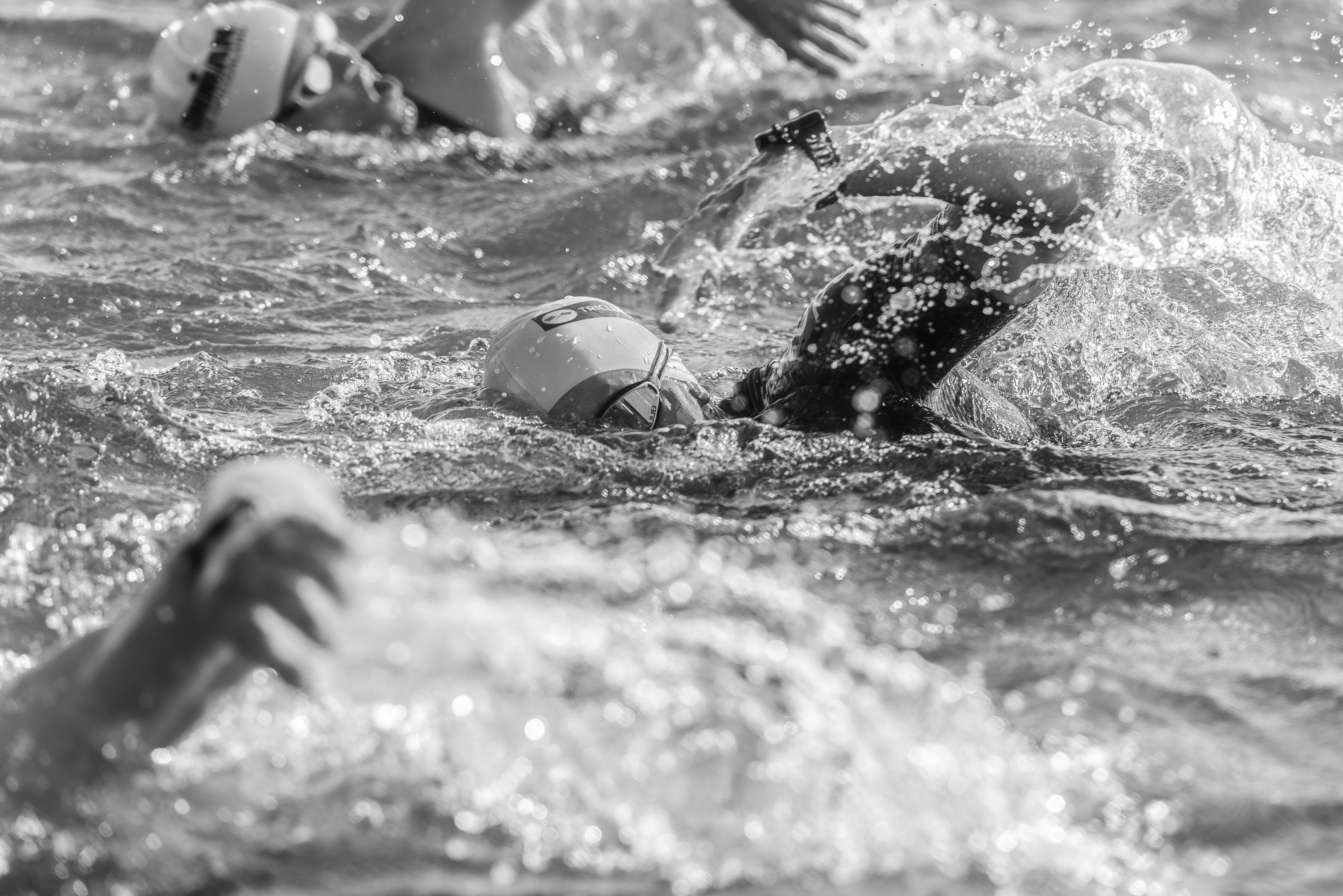
Triathlon is probably the toughest sport in the world. It combines three sports that, individually, are among the most challenging: running, cycling, and swimming. And in the world of triathlon, the Ironman is the crowning glory, while the Olympic Triathlon is shorter and therefore more intense… which of the two is more challenging? Let's find out the differences.
Birth of Triathlon
The Ironman is defined by the International Triathlon Union as a super-long triathlon : a 3.86 km swim, a 180.260 km bike ride, and a 42.195 km run (i.e., the distance of a marathon). The Olympic triathlon, on the other hand, consists of a 1.5 km swim, a 40 km bike ride, and a 10 km run. How and when did the Ironman discipline originate? In 1977, in a coincidence that was as picturesque as it was random, thanks to a bet between a group of friends in Honolulu, Hawaii. These friends were arguing about which race was the toughest in terms of endurance: the Waikiki rough water swim (3.8 km swim), the 112-mile bike race around Oahu (180 km bike ride), or the Honolulu Marathon (42.195 km run). Someone suggested combining the three events to form a single race. A suggestion that sparked hilarity among the group, but which actually gave birth to triathlon, with the distance still considered the most important today, the Ironman. From that small group of friends was born the Hawaii Ironman , a race that is still considered one of the most prestigious today.
The toughest discipline in the world
There's no mistaking triathlon as the toughest sport in the world . It's a discipline that's certainly not for everyone, for several reasons:
- you need to be reasonably skilled in three different sports
- it is necessary to endure very hard training
- you need to optimize your days to be able to train
- a high level of mental toughness is required
Let's look at these 4 aspects in detail.
Running is as natural as walking; everyone can do it, barring the differences in talent and preparation that separate professionals from amateurs. Much the same could be said of cycling, but cycling is a sport that already requires a certain level of technique and very specific training. Swimming is even more niche: few people can handle the water like true athletes. Therefore, it's by no means a given that a person, or athlete, is gifted in all three disciplines.
Training for not one, but three sports forces the body to endure significant loads and stress. It's no coincidence, in fact, that many athletes attempt triathlons but are unable to cope with the excessive demands this discipline imposes.
And preparing for three sports at once, of course, takes time. This is one of the details that most impacts the preparation of an athlete who wants to tackle a triathlon. When to train? How to divide the training sessions? It's not easy to optimize your time to fit all your commitments, both life and sport.
Davide Uccellari: Discover how a professional trains for triathlon.
Physical, but especially mental, fatigue are the most challenging obstacles when preparing for a triathlon. Exhausting training sessions, unpredictable schedules, and recovery periods that can be very challenging for the body and mind. For this reason, recovery plays such a fundamental role in this sport, almost as if we could call it the "fourth discipline."
In fact, the real secret is being able to rest effectively, recover well between training sessions, and not be excessively stressed. Only in this way can you be a competitive triathlete.
Ironman
The name says it all: a race for men (and women) of iron. And indeed, it's a bit like that. You have to be very resistant, almost indestructible, to complete an Ironman race. In the world of running, and amateur sports in general, anyone who crosses the finish line of a marathon or completes a granfondo cycling race is considered a "hero." It's almost chilling to think that in an Ironman, the marathon, and a bike distance that's equivalent to more than a granfondo, are only two of the three legs of the competition. So, how can you best prepare for an Ironman race ?

Race
Preparing for a long and tough race like the Ironman requires the right precautions and adequate training planning and programming.
To train for the running portion, you need to plan specific sessions and carefully balance quality and quantity. Many triathletes preparing for the Ironman run a marathon to put miles in their legs, without worrying too much about the clock or placing.
During the initial preparation period, the primary goal is to build an aerobic base and general muscular strength. Long, slow running sessions on mixed terrain, including hills and flats, are essential during this period. As your physical condition improves, the duration of your training sessions increases, with runs lasting between two and three hours.
Once a good aerobic base has been built, the work becomes specific, and the goal is to improve running quality—namely, pace—to increasingly match the conditions you'll encounter in the race. Therefore, you need to run as long as possible at Ironman competition pace to improve your anaerobic threshold.
It's also a good idea to consider specific combined cycling and swimming workouts, given that the race distances are considerable and it's therefore difficult to manage heavy loads in single training sessions. Therefore, it's essential to train for five or six hours without a break, alternating between running, cycling, and even swimming.
Bikes
To best prepare for the bike leg of an Ironman race, you need to plan different types of workouts:
- training at a uniform pace
- training with variations in pace
- repeated on the plain
- climbs
- training combined with swimming and running
Training at a uniform pace
Even-paced training should be performed at a constant and consistent intensity, generally on flat surfaces. It's the intensity that should be consistent, not the speed.
Training with variations in pace
This workout involves varying speeds, varying in length and intensity. It can be done on both flat and undulating terrain.
Repeated on the plain
Repetitions consist of running a variable distance, usually from 3' to 8', at a constant speed, with recovery periods between each repetition.
They are generally performed on flat routes or with low-difficulty climbs, to keep the rpm always at constant values.
Climbs
Climbing is the best training for improving performance. It's recommended to:
- Short climbs at maximum speed
- Long climbs
- Medium climbs at constant speed with variations in pace, not too intense
Combined workouts
Workouts that combine all three disciplines.

I swim
This is the first leg of a triathlon race and therefore represents a crucial phase. The triathlete doesn't want, and shouldn't, gain too much of a gap from his opponents, but at the same time, he must pace himself, always remembering that the race is very long and there is time to recover.
An important first tip for training for the swimming leg of an Ironman race is to develop good aquatic skills, given that the competition takes place in open water and not in a pool.
Unlike running and cycling, which are much more natural, water is not the environment in which humans are most comfortable, and therefore training must be consistent, to gain increasing confidence and accustomed to the water.
A good swimming workout can be divided as follows:
- initial block: a 10-minute, low-intensity warm-up;
- activation block: 10/15 minutes dedicated to technical exercises, favoring other styles such as backstroke, butterfly and breaststroke;
- central block: actual training, with repetitions, lasting 20-40 minutes.
Olympic Triathlon
An Olympic triathlon lasts from an hour and a half to two hours for an elite athlete and two hours or more for an amateur. The distances are a 1.5km swim, a 40km bike ride, and a 10km run, respectively. In a competition with such short distances, you're constantly competing close to your threshold, and often beyond. For this reason, it's essential to train in specific sessions aimed at improving these aspects.
An example of a specific session in this sense is so-called "combined or brik training," which represents one of the cornerstones of preparing for these races. Combining the three disciplines is essential for training the entire body to perform three different athletic efforts and movements. Combined training involves a sequence of two different disciplines, such as swimming/cycling or cycling/running, for a specific number of repetitions, with a short transition time. The duration and intensity vary depending on the type of race being prepared for (sprint, Olympic, half-Ironman, Ironman). It can be performed both in the pre-competitive phase (away from competitions) and in the competitive phase (during competitions). It should be consistently incorporated into a training program, trying to recreate potential competition conditions as closely as possible. for example in a group, in open water, with an exit from the water of at least 100/200m, turning buoys, etc... It is important to know that triathlon requires specificity and should not be trained as the sum of 3 different disciplines.
Conclusion
Which race is tougher: an Ironman or an Olympic Triathlon? It's difficult to say because the difference lies in the intensity with which one approaches the competition. The Ironman certainly requires a greater ability to sustain sustained effort, but an Olympic triathlon is no different. Being shorter than the Ironman, it is conducted at a higher intensity and therefore becomes very tiring.
In conclusion, let's say that triathlon in general is a tough sport, and if you're looking to get started, it's best to start with shorter distances, like sprint triathlon, and then work your way up. The Ironman could be your ultimate goal, along with the Olympics.


