

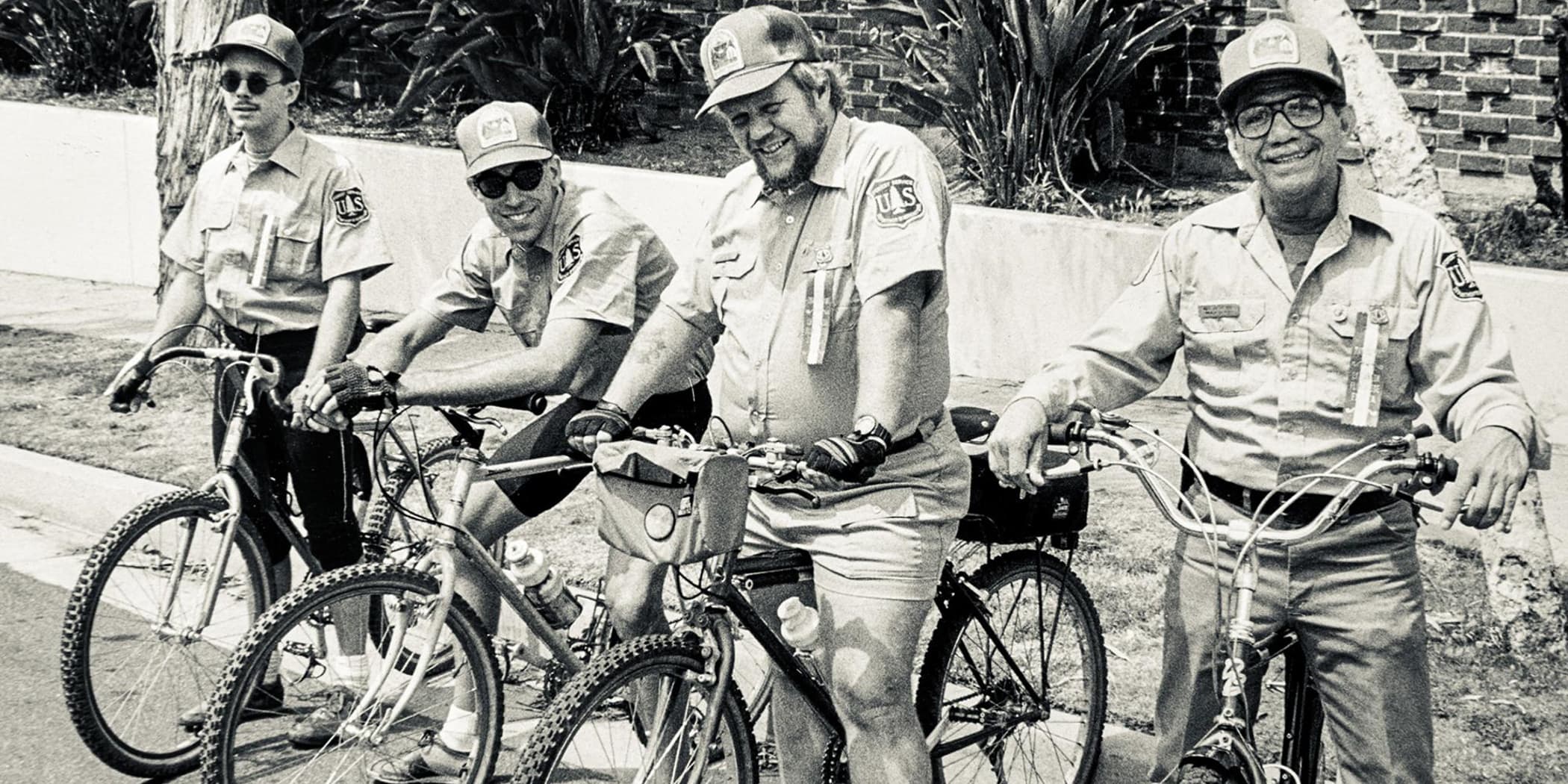
The history of the mountain bike begins shortly after that of the road bike, when the first bicycle was adapted for off-road riding. It is believed that one of the very first off-road uses of the bike was by the Buffalo Soldiers regiment of the U.S. Cavalry in Montana in 1896.
But how did we get to the modern off-road bike and the many MTB disciplines?
In this article, we'll tell you the history and evolution of mountain biking, which today boasts millions of enthusiasts worldwide, with specific and increasingly technologically advanced bikes and accessories.
When was the bicycle invented?
The first bicycle was invented in the 19th century. Although there is no clear consensus on who invented the bicycle, this stroke of genius is generally attributed to Karl Drais , a German inventor.
Drais's machine was built in 1817 under the name Laufmaschine . Curiously, it had no pedals: it had to be pushed with your feet on the ground.
It would take another 50 years or so to arrive at the bicycle as we know it today.
In between, this machine underwent several evolutions. For example, velocipedes were invented: the pedals were connected to the front wheels, but the structure was beginning to look very similar to that of modern bicycles.
The turning point came only in 1860, thanks to the Frenchman Pierre Michaux , who patented a pedal bicycle that had a decisive impact on the diffusion of this means of transport.
The arrival of the mountain bike
But let's get to the specific focus of this article: the history of the mountain bike. Its first use, as we've already mentioned, occurred in the military, with the U.S. Buffalo Soldiers.
The evolution of this “mountain bike” was rapid and today there are several types of MTB bikes.
Let's proceed in order.
MTB what does it mean?
MTB is nothing more than the acronym for mountain bike: it refers to a bicycle suitable for off-road routes, even in the mountains on steep paths.
Mountain bikes can handle grassy trails, dirt roads, singletrack , and even trails with jumps and constant changes of direction. It all depends on the type of riding you want to do.
The story
The modern mountain bike didn't arrive until the 1970s. But between the first Buffalo Soldiers expedition in Montana and the roaring '70s there were several intermediate stages that made mountain biking what it is today.
One of the first off-road bikes was the Cyclocross . To stay in shape during the winter, road cyclists would ride in the mountains, through the woods, along steep trails. This habit led to the birth of the cyclocross discipline, but also to a series of adaptations of the bike to the trails, which began to shape the first mountain bikes .
We then have some key dates in the history of MTB:
- 1966: In the USA, D. Gwynn built the first mountain bicycle, a bike suitable for rough trails;
- 1970s: The trend of klunker bikes develops. These are road bikes adapted to rough trails;
- In 1977, a group of cyclists, including Joe Breeze, Gary Fisher, and Charlie Kelly , began building custom mountain bikes, building on the designs of klunker bikes and adding significant improvements to various parts of the bike. These pioneers are often considered among the founders of modern mountain biking;
- 1979: Geoff Apps developed a bicycle with tires suitable for snow and muddy terrain. The bicycle remained on the market until 1984.
Starting in the 1980s, mountain biking became a popular sport, with millions of participants worldwide. A gradual differentiation of disciplines began. In the early 1990s, after recognition by the International Cycling Union (UCI ), the first competitive downhill and cross-country races began.
MTB disciplines today
Here is a list of the most popular MTB disciplines today:
- Cross Country : speed races on dirt tracks, but without particular technical difficulties;
- Downhill : speed races on completely downhill tracks;
- Enduro : a discipline that combines elements of downhill and cross country;
- Freeride and Slopestyle : disciplines characterized by jumps and acrobatics.
However, mountain bikes are also used for recreational purposes in mountain cycle touring and sometimes in cycle tourism, where however gravel bikes are usually specifically preferred.
MTB: which one to choose?
The choice of mountain bike depends on the type of discipline you practice. Today, there are several types of highly specialized bikes for different competitions, not to mention the growing popularity of e-MTBs.
If you're new to mountain biking, for example, you might also consider buying a used MTB or an entry-level bike.
There are some features you should still pay attention to:
- The bike measurements must respect your biometrics;
- Responsiveness is an important feature in almost all MTB disciplines;
- The wheels must be suitable for MTB terrain.
The characteristics of modern MTB wheels
In MTB, the right wheels are essential for tackling trails safely and with good performance. Wheels have evolved along with the mountain bike and today have some features that significantly differentiate them from road wheels. The choice of MTB wheel also depends on the type of discipline you intend to practice, but we can identify some common characteristics:
- Wheel diameter : These have a smaller diameter than road wheels. The diameters used in the MTB world are 26 inches, 27.5 inches, and 29 inches;
- Tire Width : MTB wheels have wider tires, which can range from about 2.0 inches to 2.8 inches or more and provide better cushioning;
- Rim profile: MTBs often use wheels with a high profile, which are more resistant to impacts and stresses on rough terrain;
- Braking system : nowadays it is preferable to mount disc brakes on MTBs to have more effective and consistent braking even when going downhill and on wet surfaces;
- Coverage : MTB riders increasingly prefer to use tubeless covers, which are less prone to cuts and punctures.
Do you have everything you need to start mountain biking? Download our checklist now and discover the must-have accessories.


