

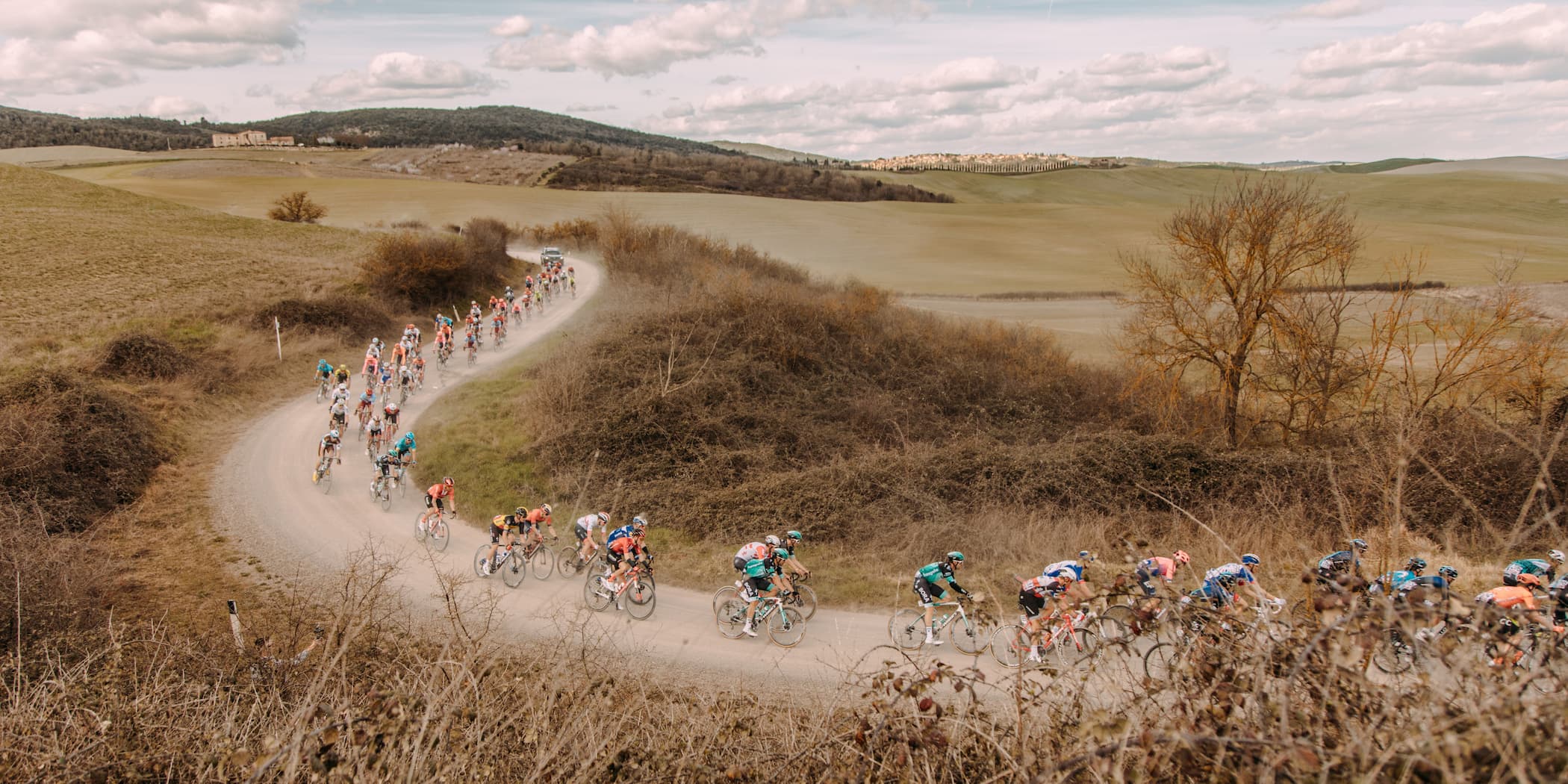
Many say it could one day become one of cycling's Monument races. A milestone that would cement the competition's beauty and allure. Which race are we talking about? The Strade Bianche. An event born in 2007, so very young, but which has quickly become one of the most beloved among professionals, industry insiders, and enthusiasts.
A long story… just a few years
Don't let its age fool you. The Strade Bianche is indeed very young, celebrating its 13th anniversary in 2020, but it is the envy of many older sporting events, precisely because of the prestige it has achieved in such a short time. This prestige has come quite naturally, thanks to the beauty of the route, the landscapes it traverses, and the allure of the roads on which cyclists compete. Strade Bianche has always evoked powerful emotions in the world of cycling: dirt, mud, and gravel are elements that usually have little to do with road cycling, but when they come together, they create an explosion of emotion and legendary moments. The hills of Chianti , San Gimignano , Siena , Montalcino , and other areas of the Sienese province... in short, some of the most beautiful places in the world. This is all the beauty that the Strade Bianche brings to the table, a race that in just a few years has already become an epic challenge for cyclists.
The perfect cyclist
The Strade Bianche route is famous for being not only breathtakingly beautiful, but also very demanding, at times very tough. The Siena race has much in common with the two great "northern classics": the long, arduous stretches on rough roads, like the Paris-Roubaix , and the numerous and formidable walls, typical of the Tour of Flanders . For this reason, there is no doubt that not all riders are suited to this competition, or at least not all can hope to win it. Who is the right cyclist for this race? We could say a modern cyclist, that is, not a classic climber, not a pure sprinter, and not a rouleur, but an athlete who can combine these characteristics, particularly those of speed and pace. Looking at the brief roll of honor of the Strade Bianche, it is easy to understand who are the cyclists best suited to this route, riders who possess these qualities:
- Fabian Cancellara , the Swiss who has already won this race three times
- multiple world champion Peter Sagan
- the phenomenal Julian Alaphilippe
- the expert Philippe Gilbert
It therefore requires considerable stamina, great strength to push hard on the hills and climbs, and a solid stamina. The race takes place in early March, so not all riders are at 100% fitness, which is why surprises are always possible, as in 2018 when Belgian Tiesj Benoot won.
The route
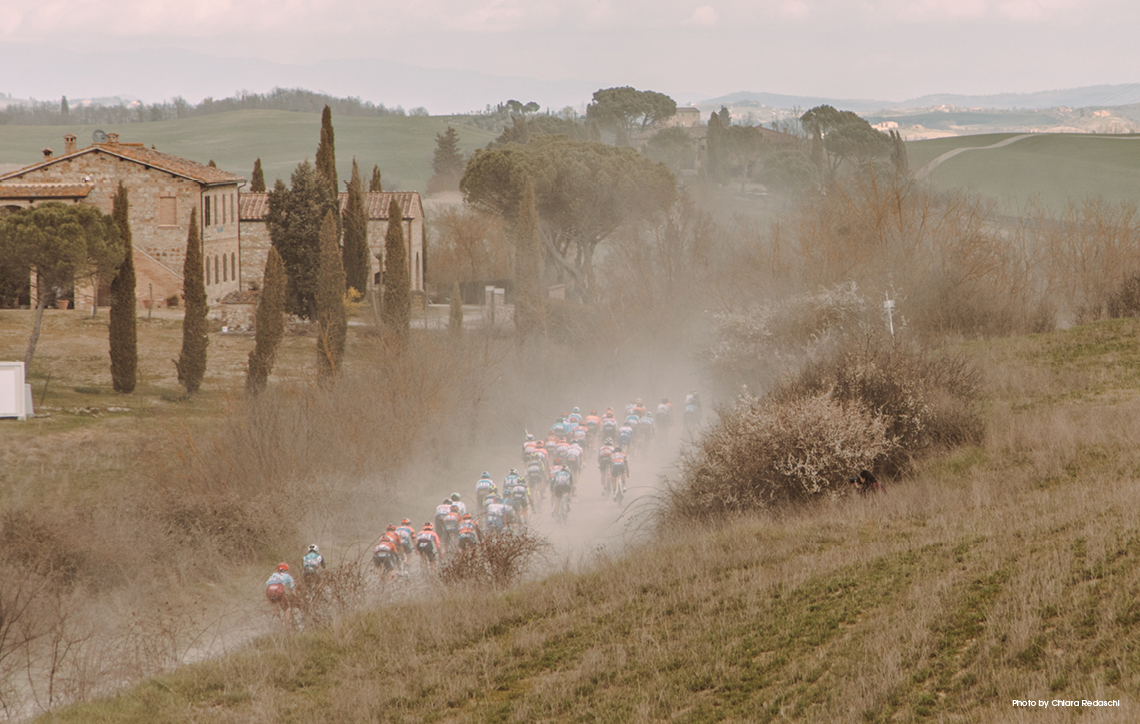
The Strade Bianche route, 184 km in total, is very winding and undulating, both in terms of elevation and contour. There are no long climbs, but there are some fairly steep sections, especially on dirt roads. There are 63 km of white roads, i.e., gravel and dirt roads, divided into 11 sectors.
A route that can also be cycled by amateurs and enthusiasts with a gravel bike .
- The start is from Siena and the first kilometres, although undulating, are calm and entirely on asphalt.
- At the 18th kilometer mark, the first dirt sector , 2.1 km long, presents the cyclists' first challenge on a gravel road. Sector 1, in reality, doesn't present any major difficulties; it's completely straight and very slightly downhill.
- Shortly after comes the 2nd sector , 5.8 km long, and this presents the first pitfalls of the race, with a short slightly downhill section and a long uphill section, with gradients that even reach 10%.
- The third sector , 4.4 km long, is located near the town of Radi, followed immediately by the fourth sector , "La Piana." Both sectors are not particularly challenging. After a few more kilometers, cyclists are called upon to tackle the Montalcino climb, the second climb of the race, 4 km long with an average gradient of 5%.
- Sector 5 is the longest, at 11.9 km . Here, fatigue is undoubtedly already felt by many athletes, especially since just one kilometer into the next dirt section, Sector 6 , which is 8.0 km long. These sections are very tense, with numerous bends and ups and downs, making them physically demanding, but also mentally demanding, requiring a high level of concentration. Less trained legs here already feel the initial strain, which is why it's so important to pace yourself well during a race like the Strade Bianche.
- The route passes through the municipality of Buonconvento for the second time, where there is a regular refreshment point. The seventh dirt sector , San Martino in Grania, reaches its 9.5 km length, nestled in the Crete Senesi. It's a challenging section, with gentle ups and downs in the first section, before concluding with a rather steep climb.
- Once you reach Ponte del Garbo, Sector 8 begins, a decidedly long 11.5 km long section, considering the time of day and the fact that it's the toughest of the Strade Bianche. It's almost entirely uphill, with several ups and downs and very steep gradients.
- After a very short 300-metre flat dirt road, the 9th sector is tackled, which is only 800 metres long, but is characterised by a steep section with gradients exceeding 10%.
- After Pieve a Bozzone, the cyclists are called upon to tackle the 10th and penultimate sector, 2.4 km long, which on the uphill road to Colle Pinzuto reaches gradients of 15% . At this point, many riders raise the white flag.
- A few kilometers later lies the 11th and final dirt road section , just over a kilometer long, with a steep descent followed by a fast climb with a maximum gradient of 18%. There are now only 18 kilometers to go to the finish line.
- The final kilometers are covered for a stretch outside the city of Siena, first downhill and then uphill, until reaching just 2 km from the finish line, when the cyclists take the Via Esterna di Fontebranda, a very steep climb, with gradients of up to 9%. A little less than a kilometer from the finish line, the paved road begins and the gradient exceeds 10%, reaching peaks of 16% on Via Santa Caterina . This is a difficult section to describe as an understatement. The route turns onto Via delle Terme and merges onto Via Banchi di Sotto. About 300 meters from the finish line, the road begins to slope slightly, leading cyclists to Piazza del Campo .
The boldest, toughest, bravest, and strongest cyclist of the day will raise their arms in victory. The Strade Bianche is a race that can't be won by just any rider, but only by those with legs, heart, and guts to spare.


